


Introduction of RIKEN-GenoMapper, Mapping Viewer System
- Hidenori Kiyosawa1,2,
- Tsugumi Kawashima1,
- Yuki Hasegawa1,2,
- Itaru Yamanaka1,
- Katsunaga Sakai1,
- Shinji Kondo1,
- RIKEN GER Group1,
- GSL Members3,4, and
- Yoshihide Hayashizaki1,2,3,5
- 1Laboratory for Genome Exploration Research Group, RIKEN Genomic Sciences, Center (GSC), RIKEN Yokohama Institute, Suehiro-cho, Tsurumi-ku, Yokohama, Kanagawa 230-0045, Japan
- 2Division of Genomic Information Resource Exploration, Science of Biological Supramolecular Systems, Yokohama City University, Graduate School of Integrated Science, Suehiro-cho, Tsurumi-ku, Yokohama 230-0045, Japan
- 3Genome Science Laboratory, RIKEN, Hirosawa, Wako, Saitama 351-0198, Japan
A major motivation behind recent large-scale genome and transcriptome projects is the hope of using this information to identify human disease genes and thereby elucidate the genetic basis of disease. The positional candidate approach is a powerful technique for disease gene identification and relies on mapping diseases to a specific chromosomal location and then analyzing candidate genes at that location (Collins 1995). Applying this approach, we mapped all FANTOM2 cDNAs to the human genome (The FANTOM Consortium and the RIKEN Genome Exploration Research Group Phase I and II Team 2002), and built a viewer system (RIKEN-GenoMapper) to facilitate positional candidate cloning activities. The RIKEN-GenoMapper is available at http://fantom21.gsc.riken.go.jp/GenoMapperHs/ and the screenshots are shown in Figure 1.
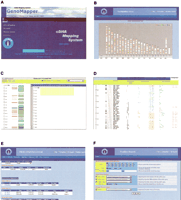
Screenshots of RIKEN-GenoMapper. (A) RIKEN-GenoMapper Menu page. (B) Navigation View Entry page where chromosomes of interest can be chosen. (C) Detailed view of each chromosome. At left, the approximate region of a chromosome can be chosen. The horizontal bars represent each mapped clone. At right, the genetic intervals of the diseases are shown. By clicking the vertical bar, the clones mapped in that interval can be seen. (D) Detailed view. A detailed description of each clone can be obtained by clicking arrows or the clone ID. (E) Detailed data of each clone. Chromosome mapping positions and other genes mapped to the same region are shown. Also available are links to the genome splicing pattern, alignment to the genome sequence, functional annotation of FANTOM2, and expression analysis by DNA microarray (not shown in Fig. 1). (F) Position search page. Once the chromosomal region of interest has been defined by microsatellite markers, the list of the genes mapped there can be obtained.
Because of the uniqueness of these sequences, they offer the potential for major advances in human disease gene identification. The ability to identify novel candidate genes for a wide range of hereditary human diseases should dramatically accelerate success in identifying human disease genes by positional candidate cloning.



