


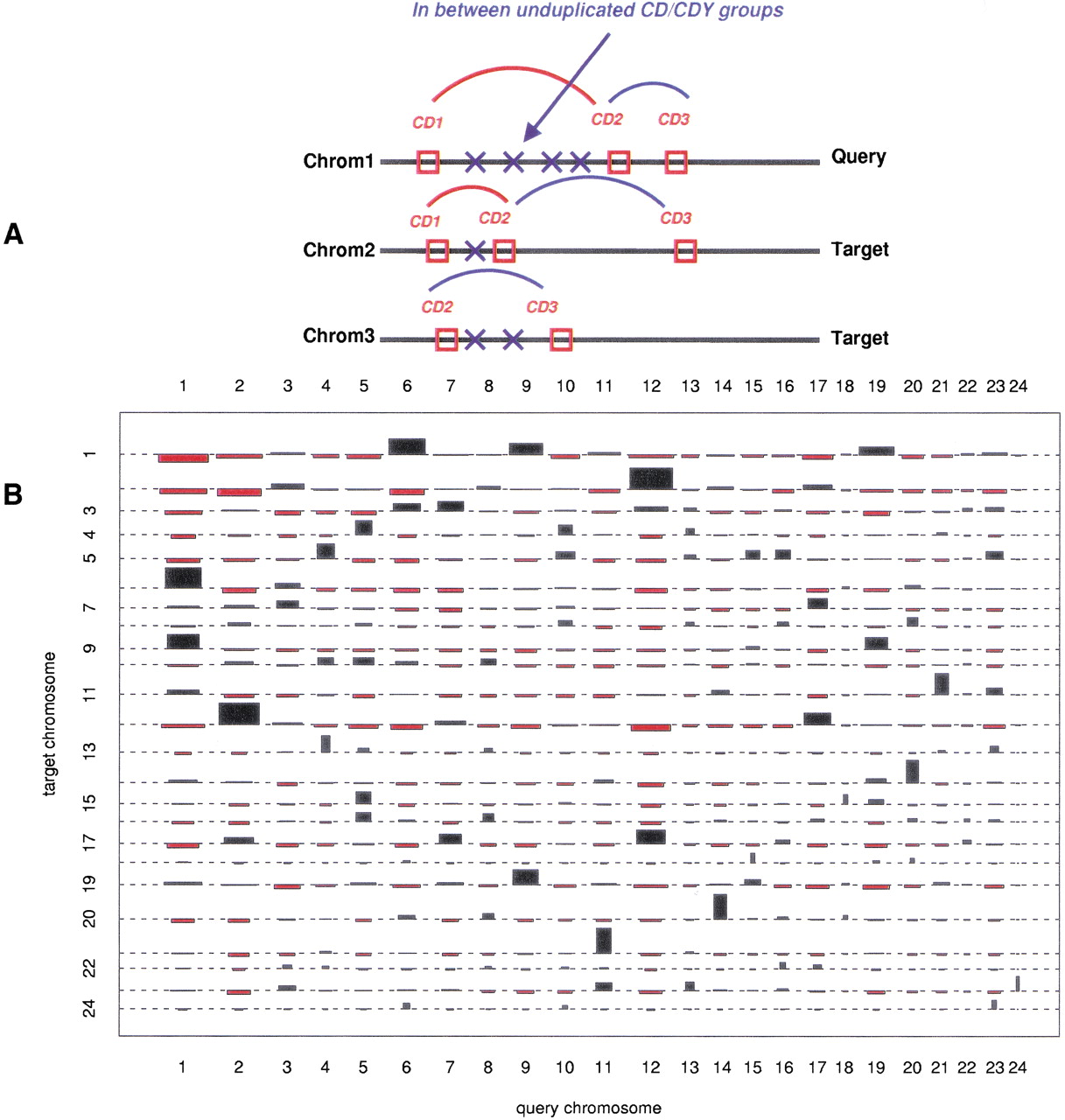
(A) A pair of orthologs, each included in one of the CD1 and CD2 orthologous groups located on Chromosome 1 have their orthologs arranged in the same order on Chromosome 2. The CD1 and CD2 are identified as a duplicated pair between Chromosomes 1 and 2. Another duplicated pair are the CD2–CD3 on Chrom1, Chrom2, and Chrom3. Because pairs CD1–CD2 and CD2–CD3 on Chrom1 have the CD2 group in common, they have been joint (named extended segments in our analysis). (B) Cohen-Friendly association plot of all-vs-all human chromosomes on the basis of detected duplicated segments. The width of each block indicates the number of pairs of CD/CDY groups shared between the respective pair of chromosomes, whereas the block height indicates the significance (as compared with a normal distribution). Black bars denote highly significant association; red bars denote cases in which the normal distribution shows higher association levels.


