


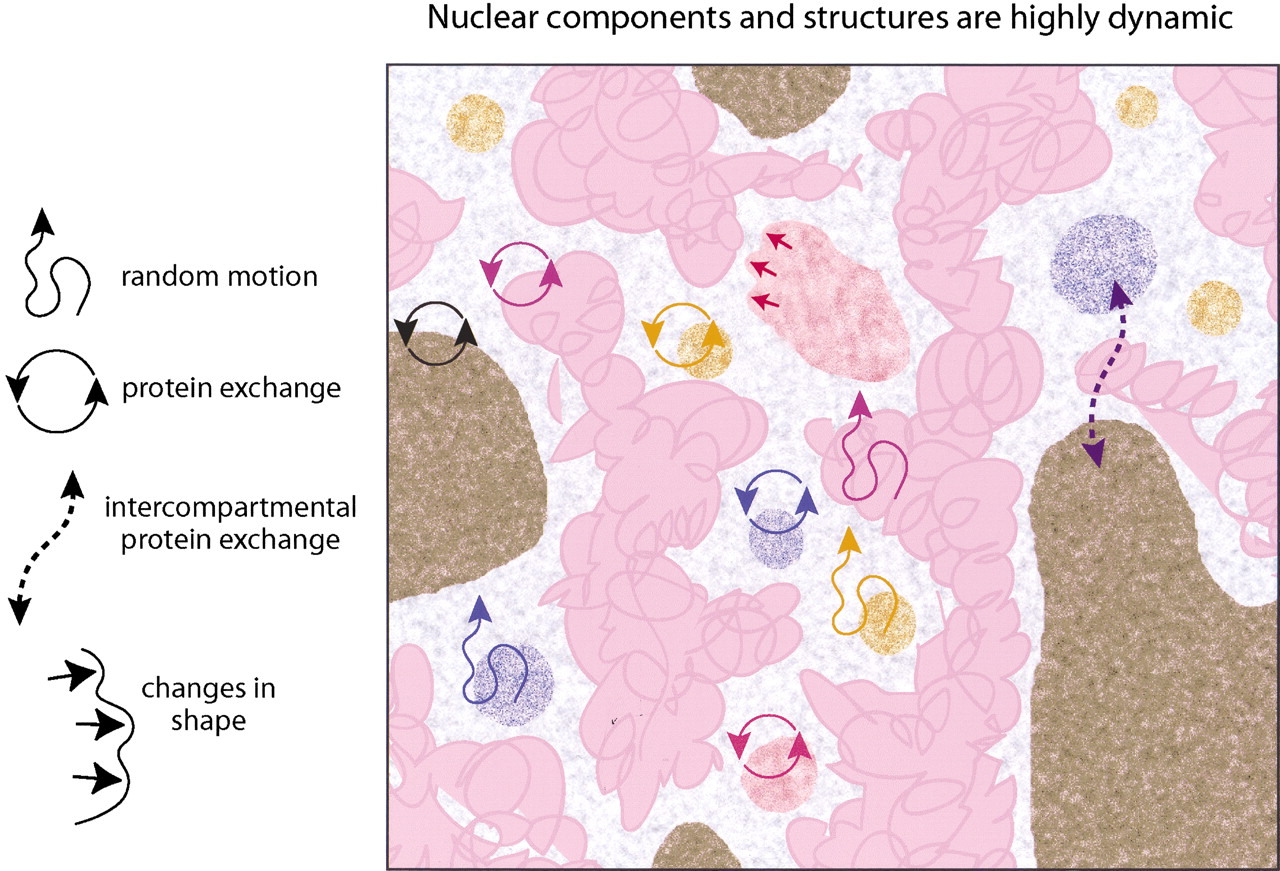
Most nuclear structures exhibit random, constrained motion. In some cases (e.g., PML or Cajal bodies) instances of energy-dependent or directed motion have been observed. Compartments may also expand to move toward interactive sites (e.g., speckles advance toward a chromosome territory) as they change shape, and thus, relative position in the nucleus. Proteins found in specific compartments typically reside only on the order of seconds to minutes within that compartment. After release, proteins migrate through the interchromatin space and associate with the same type of compartment elsewhere. However, some proteins also exhibit exchange between different types of compartments (dotted purple arrow).


