


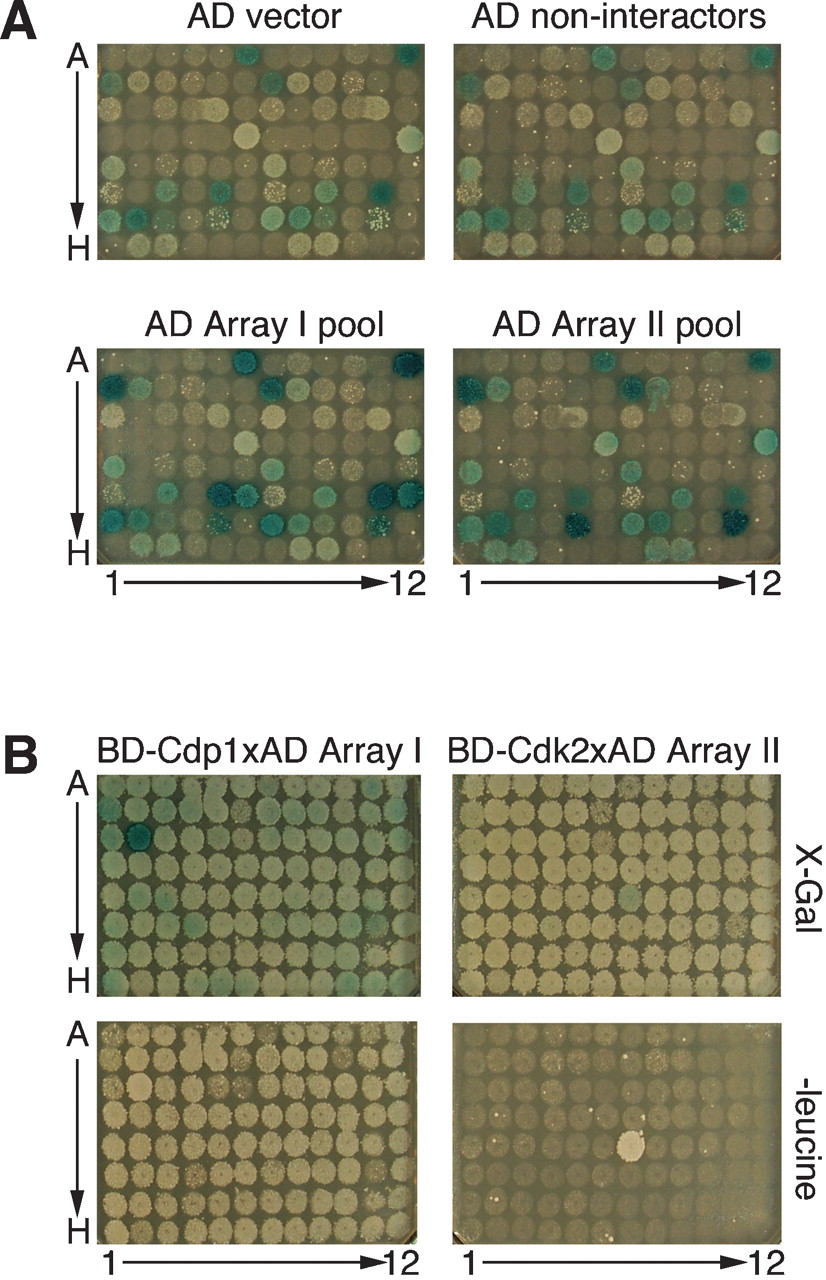
Detection of interactions using the two-phase strategy. (A) Phase 1 mating results. An array of 47 BD strains, duplicated on the right and left halves of a 96-well plate, was mated with four different AD cultures: the strain with the empty AD vector, a pool of strains from the array of 96 noninteractors (AD noninteractors), a pool of 96 strains from AD Array I, and a pool of 96 AD strains from AD Array II. Positions H6 and H12 have no BD strain. The diploids from each mating were replicated to —leu X-Gal plates. The results show that one or more strains in the AD Array I pool interact with BD fusions at positions A6, B1, B2, F5, F6, G1, and G5, and the duplicate versions on the right half of the plate. The AD Array II pool interacts with BD fusions at positions B1, B2, D6, G2, and G5, and the duplicates. (B) Phase 2 mating results. A strain expressing BD-Cdp1 was mated with AD Array I, which contains AD-Cdi3 at position C2. A strain expressing BD-Cdk2 was mated with AD Array II, which contains AD-Cdi5 at position E7. Diploids were replicated onto two kinds of indicator plates: X-Gal and —leu. The Cdk2–Cdi5 interaction is evident from growth on the —leu plate and the light blue yeast on the X-Gal plate. Because BD-Cdp1 activates the LEU2 reporter on its own, the Cdp1–Cdi3 interaction is only evident on the X-Gal plate, where the yeast are blue.


