


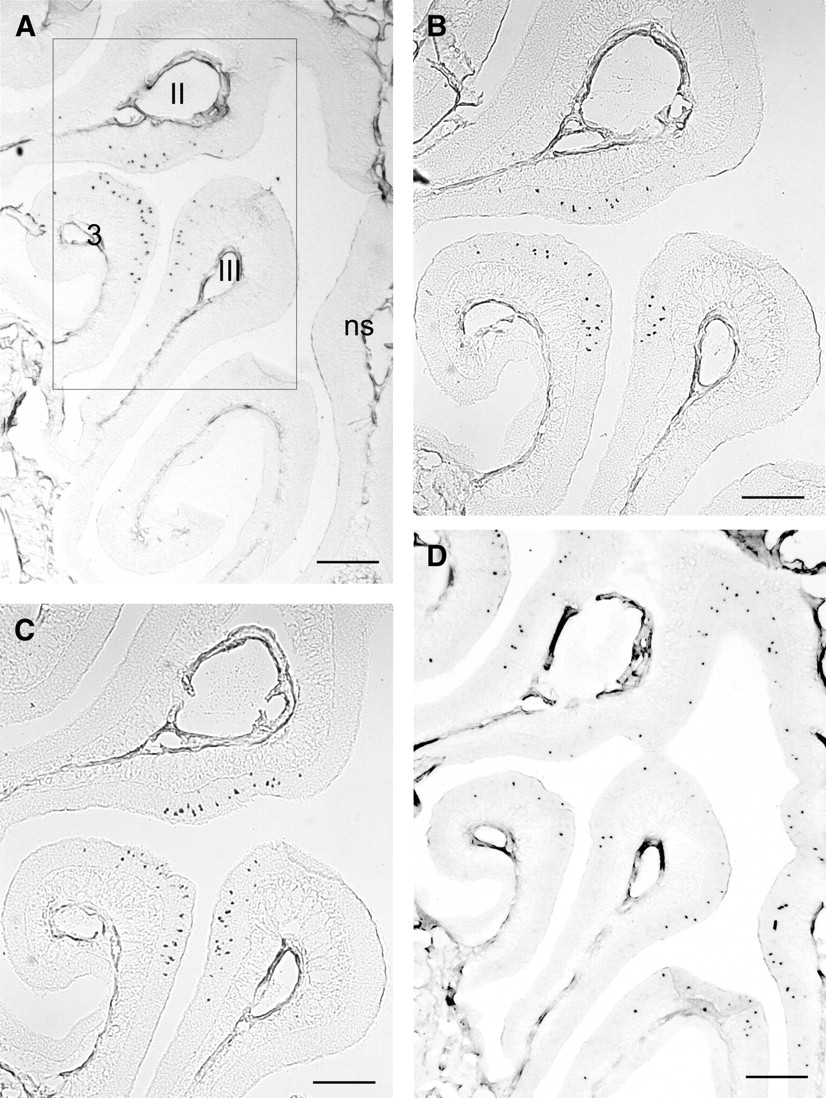
Figure 2
In situ hybridizations of digoxigenin-labeled antisense riboprobes specific for representative OR genes from chromosome 4 on adjacent coronal sections through the mouse nasal cavity.Neurons expressing a gene from family 262 are detectable exclusively in three distinct areas of the sensory epithelium, located on endoturbinates II, III, and on ectoturbinate 3 (A,B,C).A representative gene from family 259 is distributed throughout the dorsal zone of the epithelium.(A) mOR262-2, (B) mOR262-9, (C) mOR262-1, (D) mOR259-9.Boxed area in (A) is shown in higher magnification in (B,C).ns, nasal septum.Scale bars = 500 μm in (A,D) and 200 μm in (B,C).


