


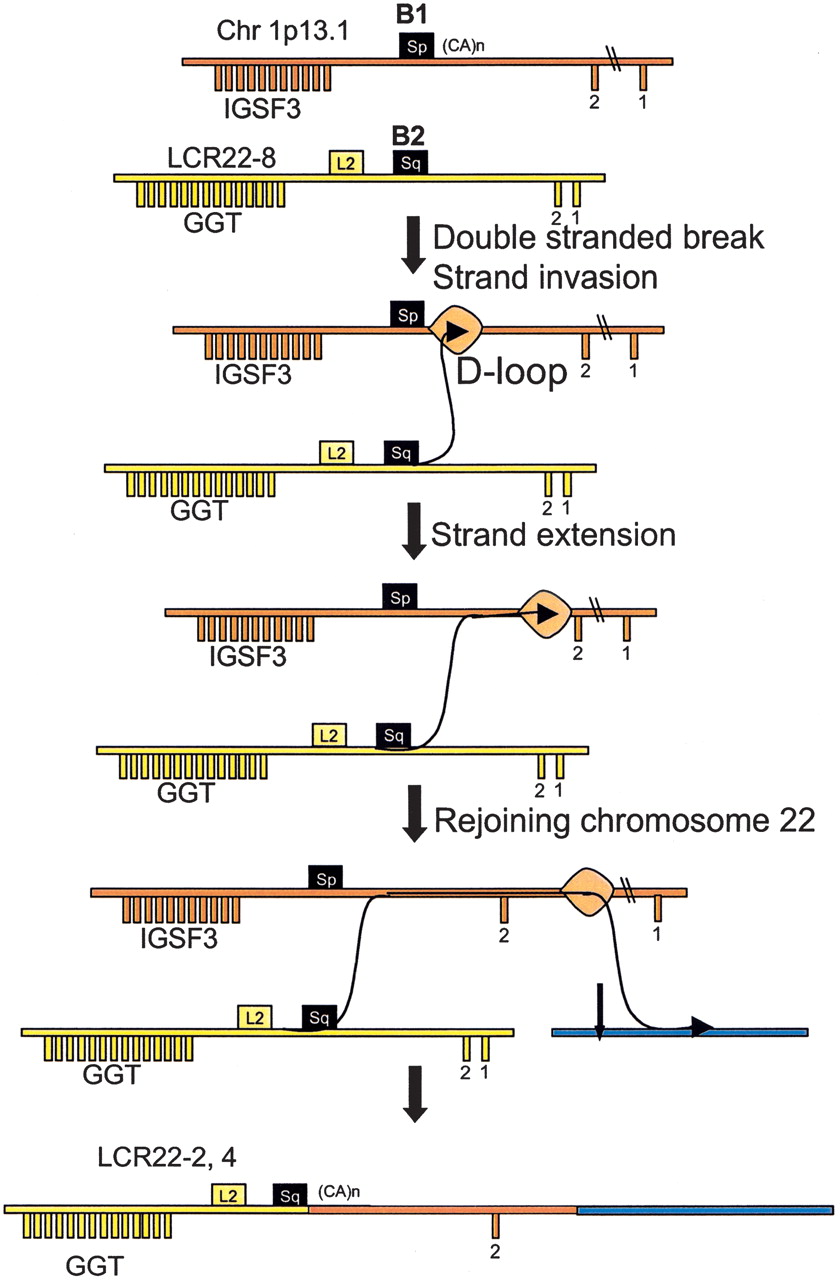
A model of insertion of IGSF3 into LCR22-2 and LCR22-4; interchromosomal recombination between IGSF3 on chromosome 1 and GGT on chromosome 22 (see Fig. 6 in Richardson et al. 1998), explaining the mechanism by which recombination occurs on nonhomologous chromosomes, thereby avoiding crossovers which would lead to aberrant translocations. In this model, a breakpoint in chromosome 22 occurred, presumably at one end of misaligned Alu elements (black boxes). The broken ends from chromosome 22 then would invade the homologous sequence, the Alu (black box) on chromosome 1, forming a D-loop. The invading end would prime DNA synthesis, extending, in this case, a significant distance on chromosome 1. The process would involve the migration of the D-loop into nonhomologous sequences downstream of the region of homology (the Alu). At a further distance, the newly synthesized strand would rejoin chromosome 22 in a region of homology (or nonhomology) between chromosomes 1 and 22. Thus, this model combines homologous recombination in the absence of a crossover with nonhomologous repair. It was proposed for mitotic rearrangements (Richardson et al. 1998), but could be envisioned for meiotic rearrangements as well.


