


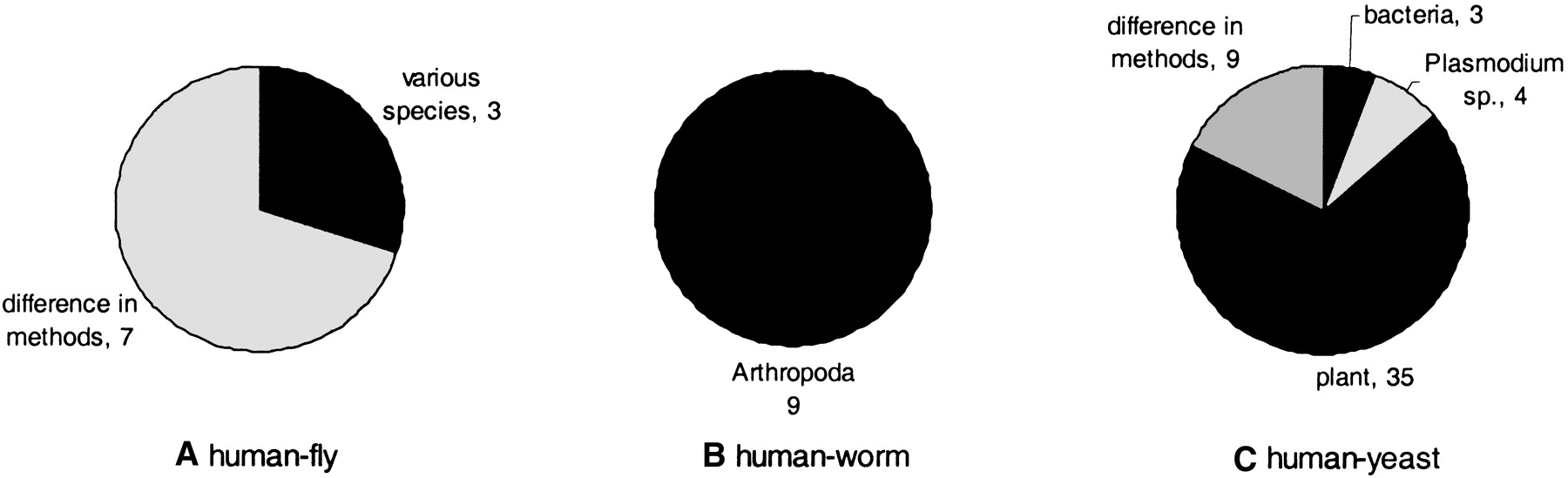
Detailed analysis for the cases in which RIO fails to assign the correct ortholog contrary to HOPS. The labels show the reason, which is usually a sequence from a particular species that prevents RIO from assigning orthology correctly. The cases that could not be traced back to a sequence preventing correct orthology assignment are due to differences in the tree-building method or the inclusion of more sequences by RIO. (A) A total of 10 potential orthologous relations are not found by RIO in the human-fly test set, but are assigned correctly by HOPS. (B) Nine orthologous pairs in the human-worm test set assigned correctly by HOPS are not found by RIO. In all cases, the sequences reflect the Coelomata, not the Ecdysozoa model of evolution (see text for further explanation). (C) Results of the human-yeast comparison, in which 51 orthologous relations found with HOPS are missed by RIO. The majority of the cases (35) are not found by RIO because the human sequence is an outgroup to a plant/yeast clade. In three cases, bacterial sequences break the assignment of orthology by RIO, indicating possible horizontal gene transfers. Four of the orthologous relations are missed by RIO because of Plasmodium sp. sequences on the Chordata branch.



