


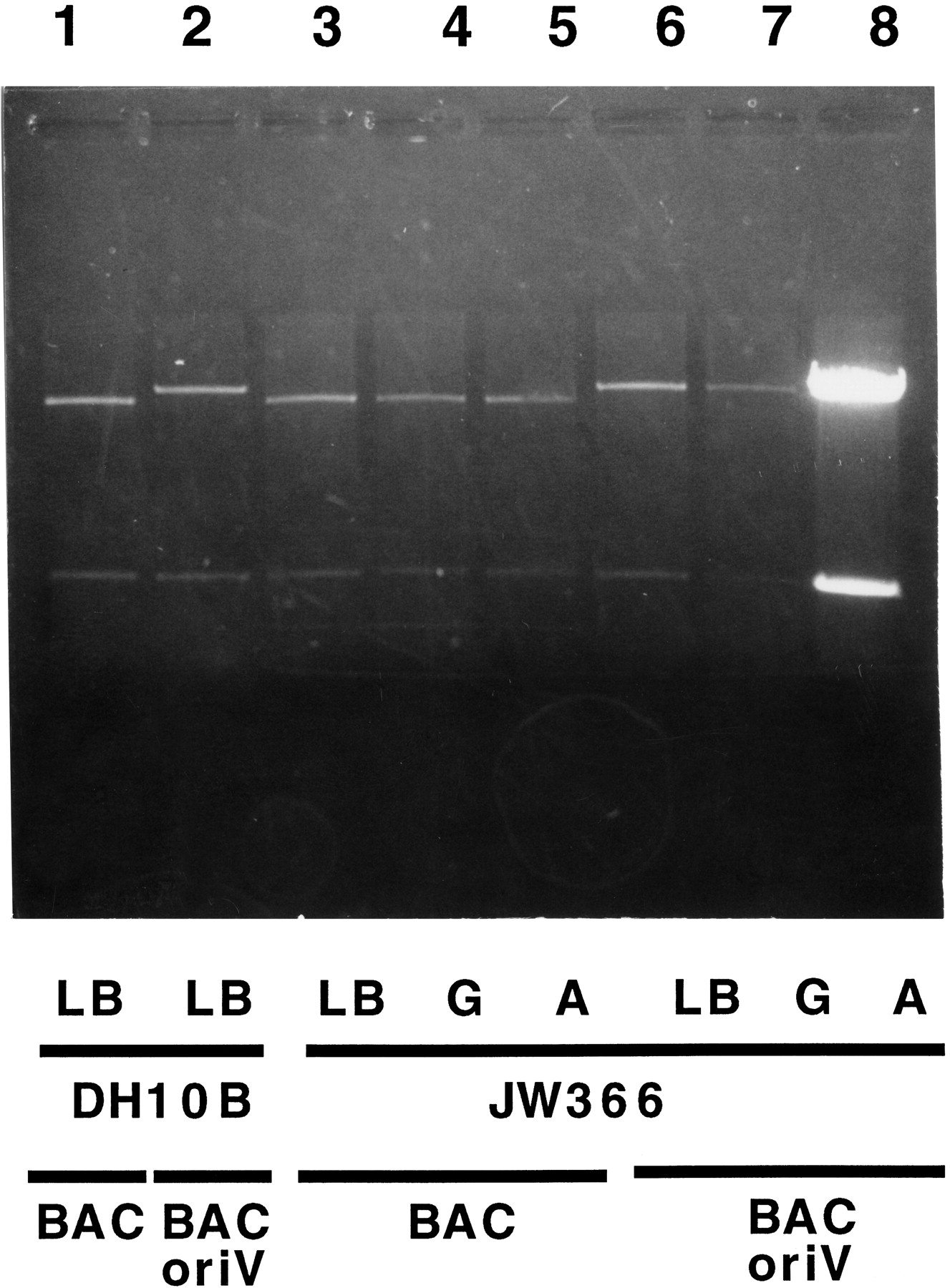
Maintenance and amplification of the pBAC/oriV vector: effects of the host, glucose, and L-arabinose-induced synthesis of the TrfA protein. The DH10B host and its derivative JW366, containing thearaC–P BAD–trfA203 cassette at the λattB site (Table 2), were transformed either with pBeloBAC11 (BAC) or pBAC/oriV (see Table 1). Transformants were grown in the Luria-Bertani medium (LB), LB + 0.2% D-glucose (G) or LB + 0.01% L-arabinose (A). After 5 h of growth, a 4.5-mL volume of each culture was centrifuged and the DNA was prepared using Wizard columns (Promega). All lanes (0.8% agarose gel) show two NcoI fragments of plasmid pBeloBAC11, either without (lanes 1,3–5) or with inserted oriV (pBAC/oriV in lanes 2, 6–8). Successful DNA amplification is seen only in lane 8, whereas lanes 1–7represent various controls. (Lane 1) pBeloBAC11 in the DH10B host grown in LB; (lane 2) pBAC/oriV in the DH10B host grown in LB; (lanes 3–5) pBeloBAC11 in the JW366 host grown in LB, LB + 0.2% G or LB + 0.01% A, respectively; (lanes6–8) pBAC/oriV in the JW366 host grown in LB, LB + 0.2% G or LB + 0.01% A, respectively. Whereas 0.2% G reduces the plasmid number to one per cell (lane 7 vs.6), induction with A amplifies DNA up to 100-fold (lane8 vs. 6). The induced high-copy (HC) replication of pBAC/oriV provides an ample amount of vector DNA for construction of libraries.



