


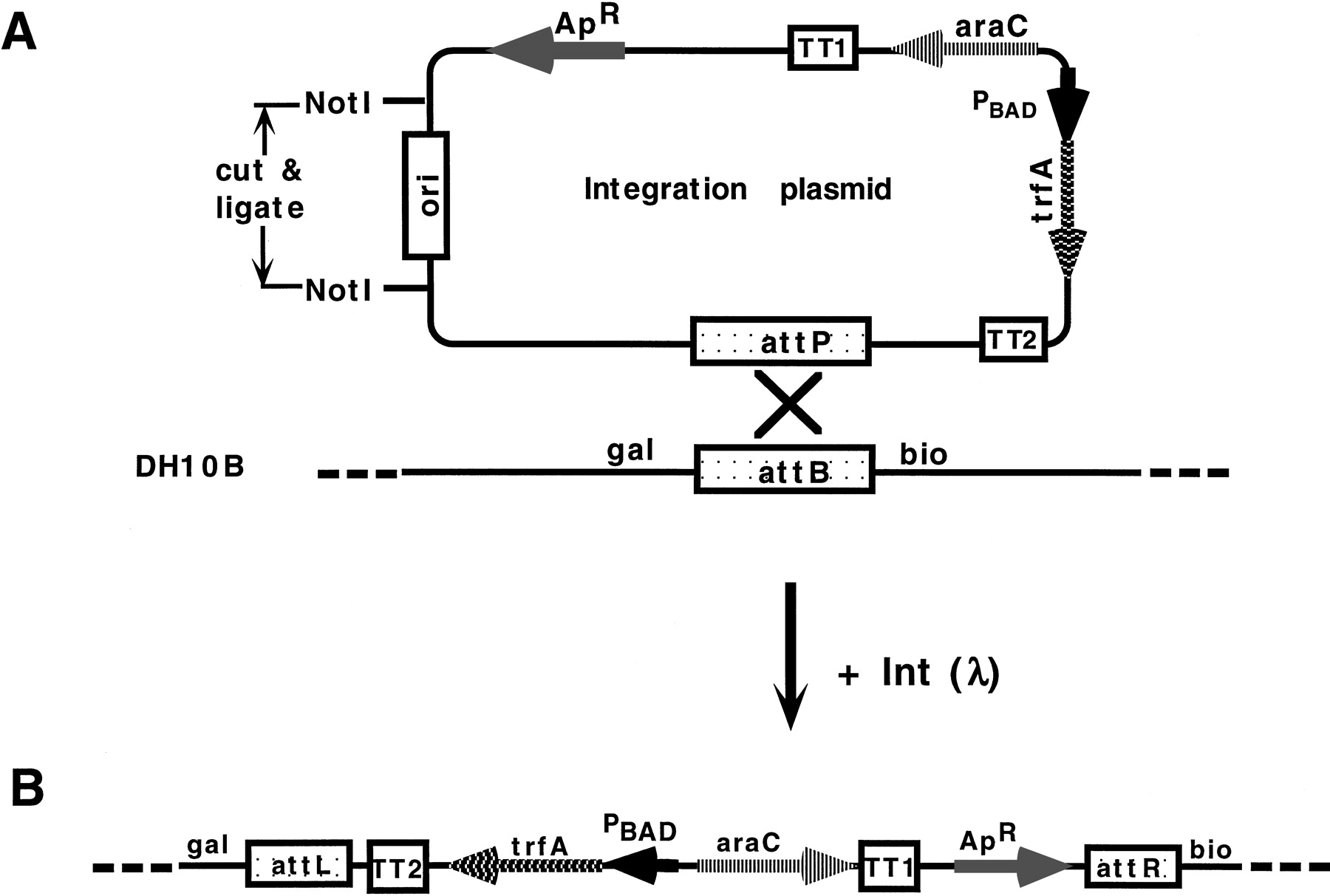
Construction of four DH10B-based hosts carrying a tightly regulatedtrfA gene that supplies, but only upon induction, the TrfA replication protein. (A) A representation of an integration plasmid and of a fragment of the host genome with the attBsite for site-specific recombination. Four integration plasmids carrying four various trfA copy-up mutations have been constructed (see Table 1), as described in Methods. Each integration plasmid carries a cassette consisting of araC–P BADfused to the specific trfA gene copy-up mutant. All integration plasmids have (1) an easily removable NotI-flankedori of plasmid pBR322, and (2) the attP λsite for site-specific integration into attB of the DH10B host genome, as shown below the plasmid drawing. (B) A diagram of the genomic segment of the host upon recombination of thetrfA-integration plasmid. Such hosts permit conditional, tightly regulated synthesis of the TrfA protein. Experimental details on Int-mediated integration of the four plasmids into the DH10B host strains (Table 2) are described in Methods. TT1 represents thet1 and t2 terminators (both clockwise) fromrrnB; TT2 represents the t L3 (clockwise) and t L1 (anticlockwise) terminators of phage λ.



