


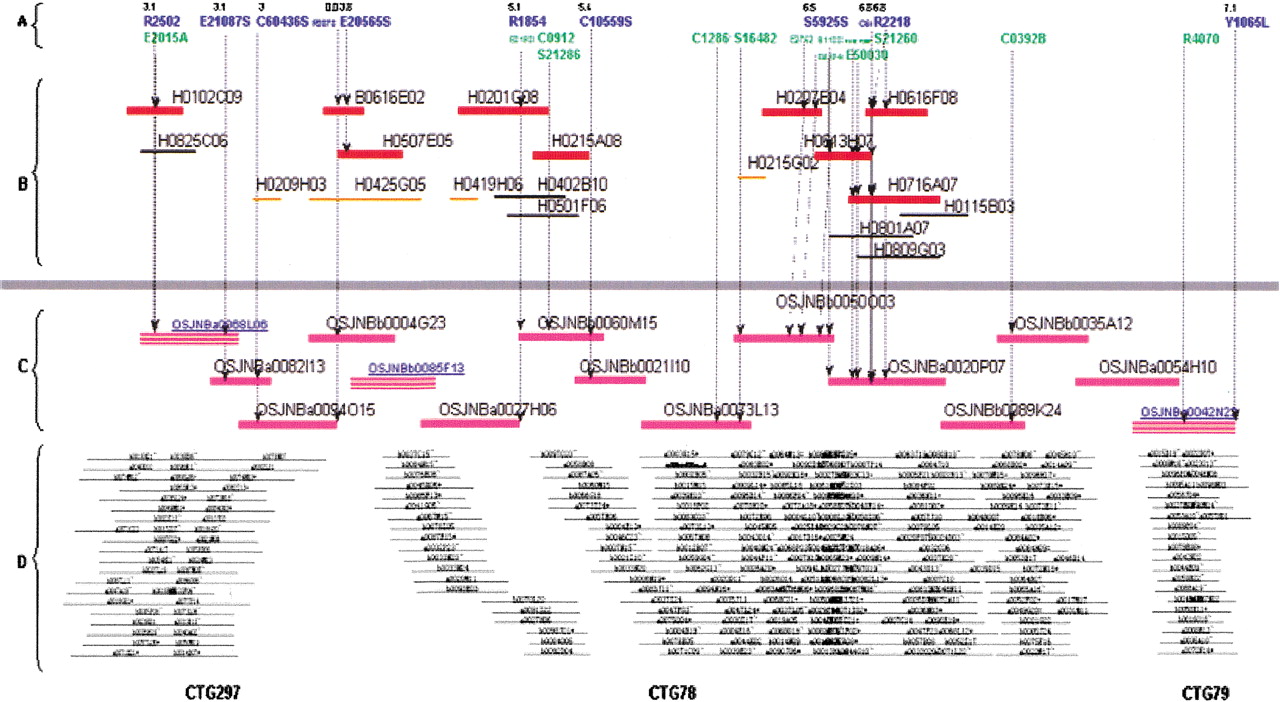
The BAC contig map of CTG4-1 near the short arm telomere together with its collinear Guangluai 4 region. (A) Markers associated with the map. Fifteen EST (in green) and 11 RFLP (in blue) markers used to anchor contigs are shown together with their genetic positions (numbers in cM). (B) Anchored Guangluai 4 BAC contigs by the markers. Fully sequenced BACs (red lines), BACs identified using the Nipponbare sequence scaffold against the Guangluai 4 BAC ends (orange lines), and other clones (black lines) in the contigs are indicated. (C) Fifteen tiled and completed sequenced Nipponbare BACs. Three bridging clones OSJNBa0094015 and OSJNBb0004G23 for joining CUGI contigs 297 and 78 and OSJNBa0054H10 for CUGI contigs 78 and 79 are shown. (D) Display of three original fingerprinted CUGI contigs 297, 78, and 79. CTG4-1 is composed of 295 fingerprinted CUGI BACs and three extended bridge clones. Contig 79 was anchored by marker Y1065L by in silico anchoring. Contigs 297 and 78 were anchored by the Guangluai 4 sequence scaffolds as indicated in syntenic positions.



