


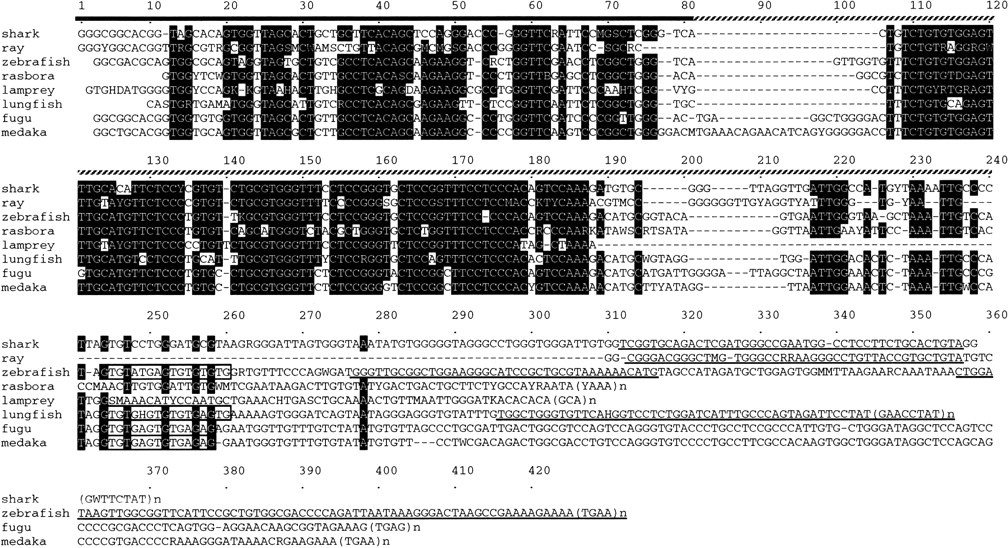
Characterization of V-SINEs. Consensus sequences of several V-SINEs from vertebrates are aligned and compared. The consensus sequences are from the gummy shark (Mustelus manazo) HE1 SINE (Ogiwara et al. 1999), electric ray (Torpedo californica) HE1 SINE (Ogiwara et al. 1999), zebrafish (Danio rerio) DANA SINE (Izsvak et al. 1996), rasbora (Rasbora pauciperforata) Ras1 SINE (this study), lamprey (Lethenteron reissneri) Lam1 SINE (this study), lungfish (Lepidosiren paradoxa) Lun1 SINE (this study), fugu (Fugu rubripes) Ac1 SINE (this study), and medaka (Oryzias latipes) Ac1 SINE (this study). Consensus sequences were deduced from six (zebrafish), three (rasbora), five (lamprey), five (lungfish), three (fugu), and two (medaka) sequences, respectively (see Supplemental Fig. 2, available online at http://www.genome.org). Nucleotides are numbered above the sequences. Under the numbers, the tRNA-related regions and the central conserved domains are indicated by a bold line and by a dotted line, respectively. (TG)n tracts are boxed. Nucleotide sequences in 3′ tails that are nearly identical to those of partner LINEs are underlined. Nucleotides are highlighted in black when at least six are identical at a given position.



