


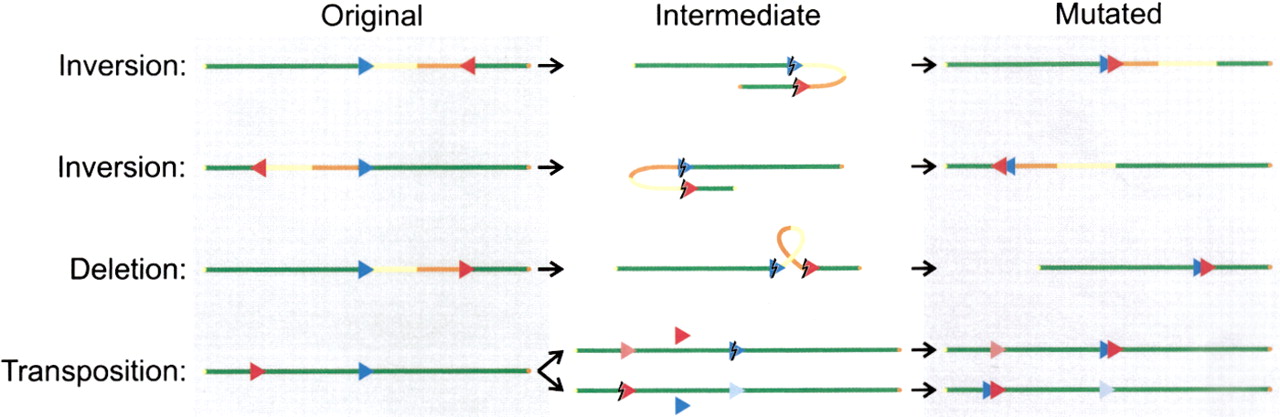
Schematic depiction of proposed mechanisms for observed intrachromosomal rearrangements. The blue and red arrows indicate the orientation of the integrated plasmid loci and the recovered mouse sequences, respectively, on the original non-rearranged chromosome (left column). All four combinations are given for an arbitrarily orientated chromosome (green line). The middlecolumn shows how two breakpoints (lightning signs) could lead to the inversion or deletion of the encompassed chromosomal sequence (yellow-orange dual tone line) and result in a recoverable mutation in the right column. The last row indicates the two options for a transposition, in which either the transgene locus or the recovered mouse sequence is copied or excised (as indicated by the pink and light blue arrows) and integrates in the breakpoint at the other location.



