


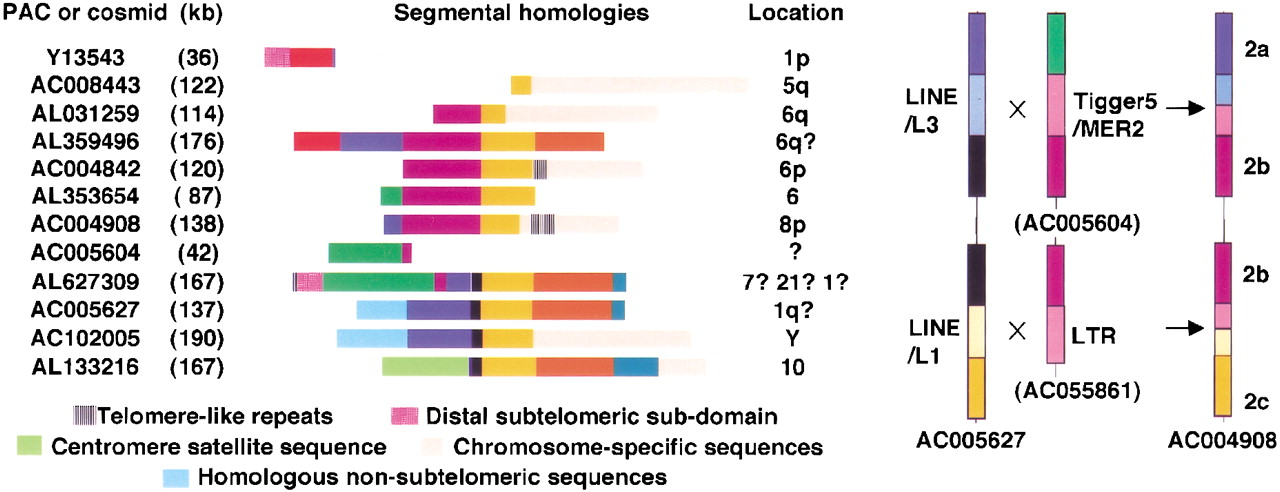
(Left) Schematic representation of the segmental organization of large genomic fragments. The colored boxes (drawn to scale) represent the different subtelomeric segments according to the code in Figure 2. All sequences are identified by their accession numbers (only finished, not draft, sequences were analyzed). The proposed chromosome location is also indicated. AC004842 is assigned to 7p22 in the GenBank; however, a 6p location was found using the Genebridge4 hybrid panel (Y.-M. Borde, unpubl.). Similarly, AC004908 (no chromosomal location indicated by NCBI) has been assigned to Chromosome 8p using the Genebridge4 hybrid panel (Y.-M. Borde, unpubl.). AL627309(previously named AC073186) has been successively assigned to Chromosomes 7, 21, and, more recently, 1, illustrating the difficulties of assigning subtelomeric genomic fragments with no obvious connection to chromosome-specific sequences. The black box represents a novel region not included in our FISH studies. (Right) Proposed illegitimate recombination events leading to the incorporation of an intervening subtelomeric region. The color code is as above with lighter colors representing the boundaries of the corresponding regions. Boxes are not drawn to scale. The sequence AC005627 carries the ancestral configuration, and AC004908 represents one of the final products after a double recombination event, implicating sequences similar to the ones found in AC005604 and AC055861. Although not found in the sequence database, the reciprocal product may correspond to theE variant observed by FISH in the population.


