


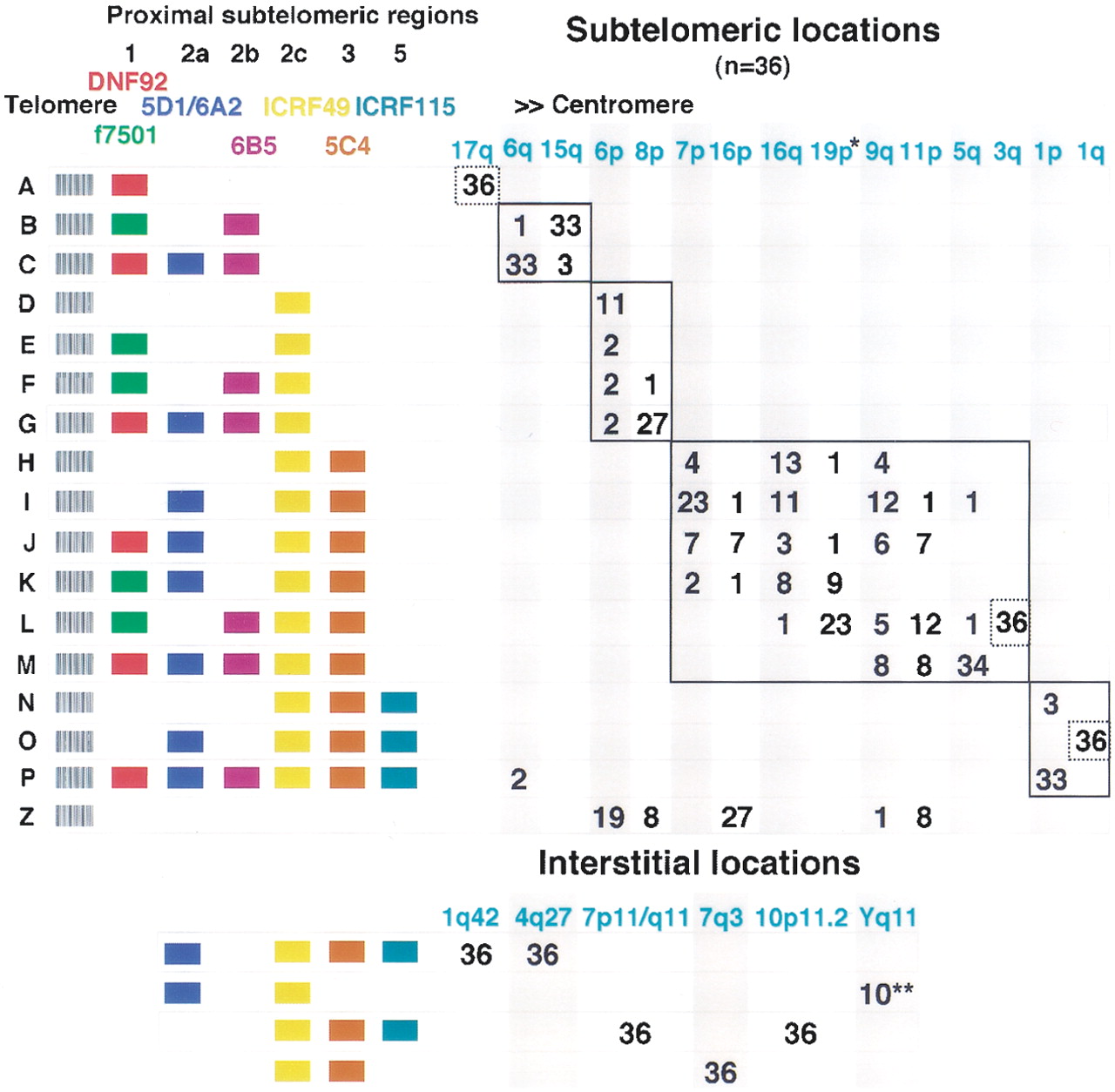
Cartography by FISH of the subtelomeric domains observed in 18 nonrelated individuals (36 haploid genomes). Colored boxes indicate that a consistent fluorescent signal was observed with the corresponding cosmid probe (color code for probes is as in Fig. 1), whereas their absence indicates no fluorescent signal obtained. The cohybridization of probes allowed, in all cases showing presence/absence of polymorphisms, the distinction between homologous chromosomes and the reconstitution of subtelomeric domains for individual chromosome arms. For a given combination, certain regions showed differences in fluorescence intensity between chromosome arms (not noted here), which may reflect additional size or sequence heterogeneity. The variants A to P were first arranged according to their complexity within the more proximal half of the subtelomeric domain, and then, within each group, according to the complexity of the more distal half. Variant Z corresponds to the absence of signal for all probes used (null allele). Homologous recombination events implicating the more proximal half of subtelomeric domains may have contributed to the shuffling of more distal sequences among the chromosome arms contained within the solid-line rectangles. The dotted rectangles outline invariable loci. (*) 34 observations, the remaining two correspond to f7501/DNF92 colocalizations in which a subtelomeric structure of type J/K was detected. (**) Out of 10 male individuals.


