


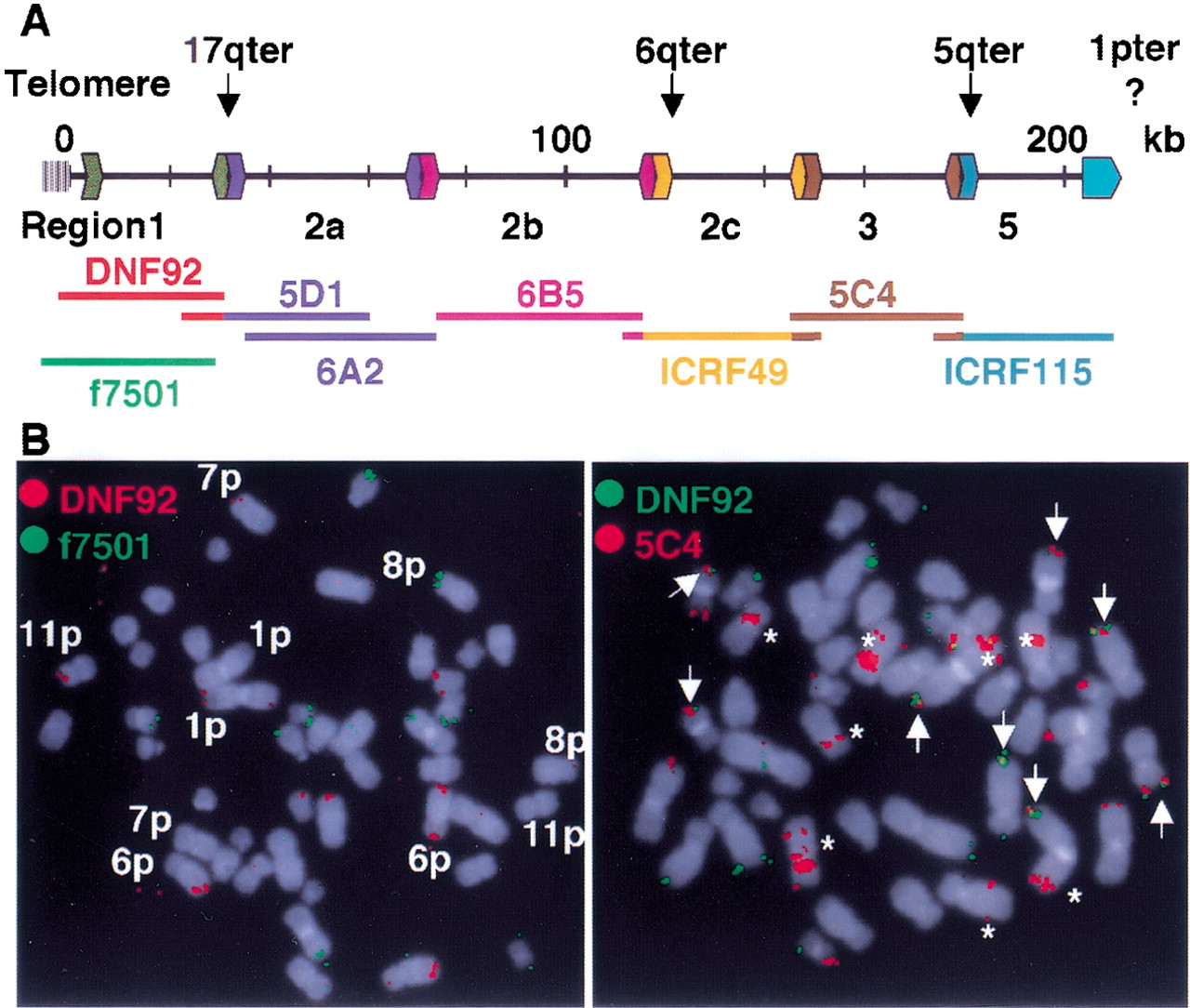
(A) Cartography of the subtelomeric domain common to Chromosome arms 1p/q, 5q, 6q, and 17q (Monfouilloux et al. 1998). The arrows indicate the limit between the subtelomeric domain and chromosome-specific sequences for three of the chromosomes. This limit has not been found for 1p/qter. The limits between regions have been previously defined (Monfouilloux et al. 1998; Vergnaud 1999), and their relative positions are indicated here. The length of the lines approximately corresponds to the size of the cosmid probes used in this study. Extremities of the same color indicate actual overlapping among clones. (B) Colocalization of probes by two-color FISH. (Left) Cohybridization obtained using region 1 probes (red and green). Chromosomes are counterstained with DAPI. Chromosome arms bearing presence/absence polymorphisms are indicated. All other locations are homozygous in this individual. (Right) Cohybridization using probes specific to regions 1 (green) and 3 (red). Arrows indicate colocalization. The 5C4 probe also hybridizes to interstitial locations (indicated with an asterisk) on Chromosomes 1, 4, 7, and 10. The results presented in Table 1 and Figure 2 only take into account signals that are distinct and consistently detected (i.e., are present in all metaphases analyzed from an individual).


