


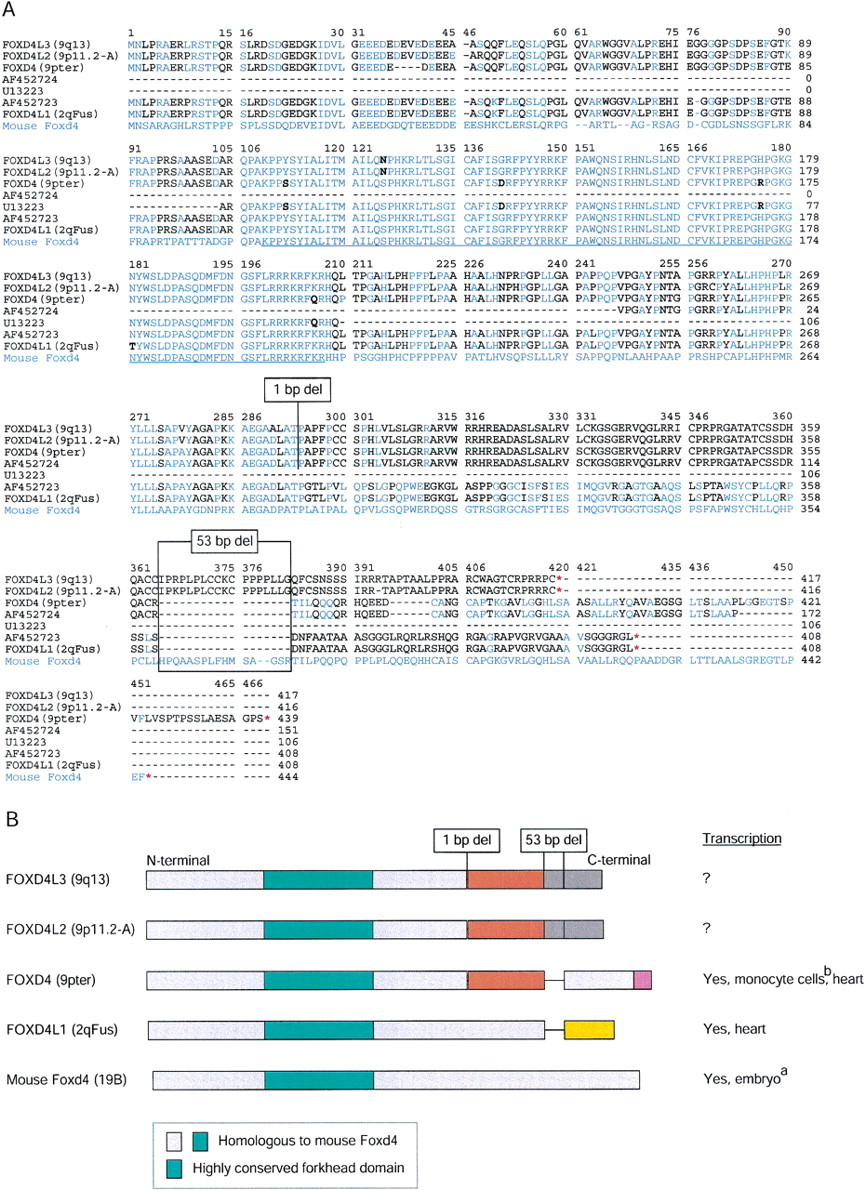
(A) Comparison of predicted amino-acid sequence of cDNA and paralogous genomic copies of forkhead FOXD4-like genes.FOXD4, FOXD4L1, FOXD4L3, andFOXD4L2 represent human forkhead domain-containing genes from 9pter, 2qFus, 9q13, and 9p11.2, respectively, derived from BAC sequences. Foxd4 is an orthologous mouse forkhead protein (fkh-2, X86368). All genes are single-exon. AF452723 andAF452724 are cDNA sequences we generated by PCR from human heart Marathon-Ready cDNAs. U13223 is a published 318-bp partial humanFOXD4 (FREAC5) cDNA (Pierrou et al. 1994). Blue residues are identical to the mouse Foxd4 protein; black residues differ from it. The underlined region indicates 100-amino-acid conserved forkhead DNA-binding domain. The locations of the 1-bp and 53-bp deletions relative to mouse Foxd4 are indicated; each causes a frame shift. Red stars indicate both stop codons. An alignment of the corresponding nucleotide sequences and locations of primers used in our analysis are in Supplemental Figure A (available online athttp://www.genome.org). (B) Summary of the putative protein structures of human FOXD4-like subfamily. Colors indicate homologous regions at the amino-acid level. Light blue blocks regions are ≥49% identical to mouse Foxd4. Green blocks are conserved forkhead domains (≥96% amino-acid identity). References for transcriptional activity are a (Kaestner et al. 1995); b (Pierrou et al. 1994); others, present study. The sequence containing FOXD4L2is tentatively assigned to 9p11.2 based on FISH results (Fan et al. 2002), but may derive from 9q13.



