


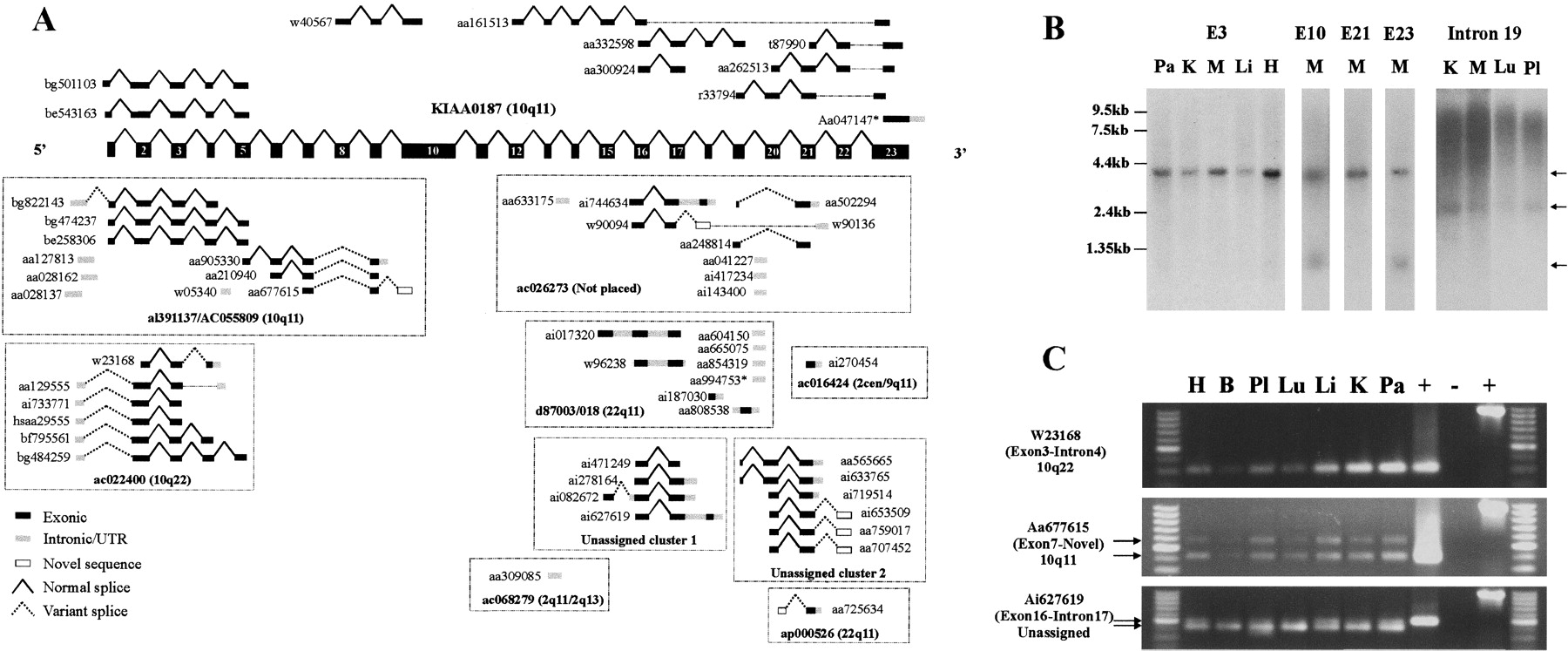
Transcriptional analysis of KIAA0187. (A) Structure of expressed sequence tags (ESTs) related to KIAA0187. The structure of KIAA0187-related ESTs is shown relative to the exon/intron organization of the functional gene with ESTs from this locus shown above the schematic. Two clusters of ESTs could not be unambiguously assigned to any genomic sequence (see Methods). The four ESTs in unassigned cluster 1 share seven nucleotides that are not present in any genomic paralog, whereas the six ESTs in unassigned cluster 2 share six unique nucleotides (data not shown), indicating that they are not derived from any of the known genomic loci. ESTs labeled with an asterisk (aa047147 from the functional gene and aa994753 from d87003/018 in 22q11) represent ∼20 ESTs with very similar structures that have been omitted for clarity. Four ESTs contain sequence unrelated to the 10q11 gene: ESTs AA677615 (10q11) andAA725634 (22q11) are both spliced to anonymous sequence; EST W90094(not placed) contains exons 16 and 17 spliced onto an Alu element; and ESTs AI653509, AA759017, and AA707452 (unassigned cluster 2) contain exons 20 and 21 spliced onto Aquaporin-related sequences. (B) Northern blots of polyA+ RNA probed with KIAA0187exons. Panels labeled E3, E10, E21, and E23 and intron 19 were probed with fragments specific for exons 3, 10, 21, and 23 and intron 19, respectively. The three transcripts are indicated with arrows. (C) RT-PCR analyses of KIAA0187 paralogs. The cDNAs shown are as follows: H, heart; B, brain, Pl, placenta; Lu, lung; Li, liver; K, kidney; and Pa, pancreas. The accession number of the ESTs used to design primers specific for the three clusters is shown to the left of each panel, as is the intronic/exonic origin of the two primers. (Middle) The reverse primer is specific for the novel sequence within AA677615 (see A). The first positive control in the top and middle panels is 10 ng of the parent EST. In the bottom panel, it is 50 ng of genomic DNA. The second positive control in all panels is a G3PDH cDNA template amplified using theG3PDH primers (see Methods). The marker is a 100-bp ladder (Promega).


