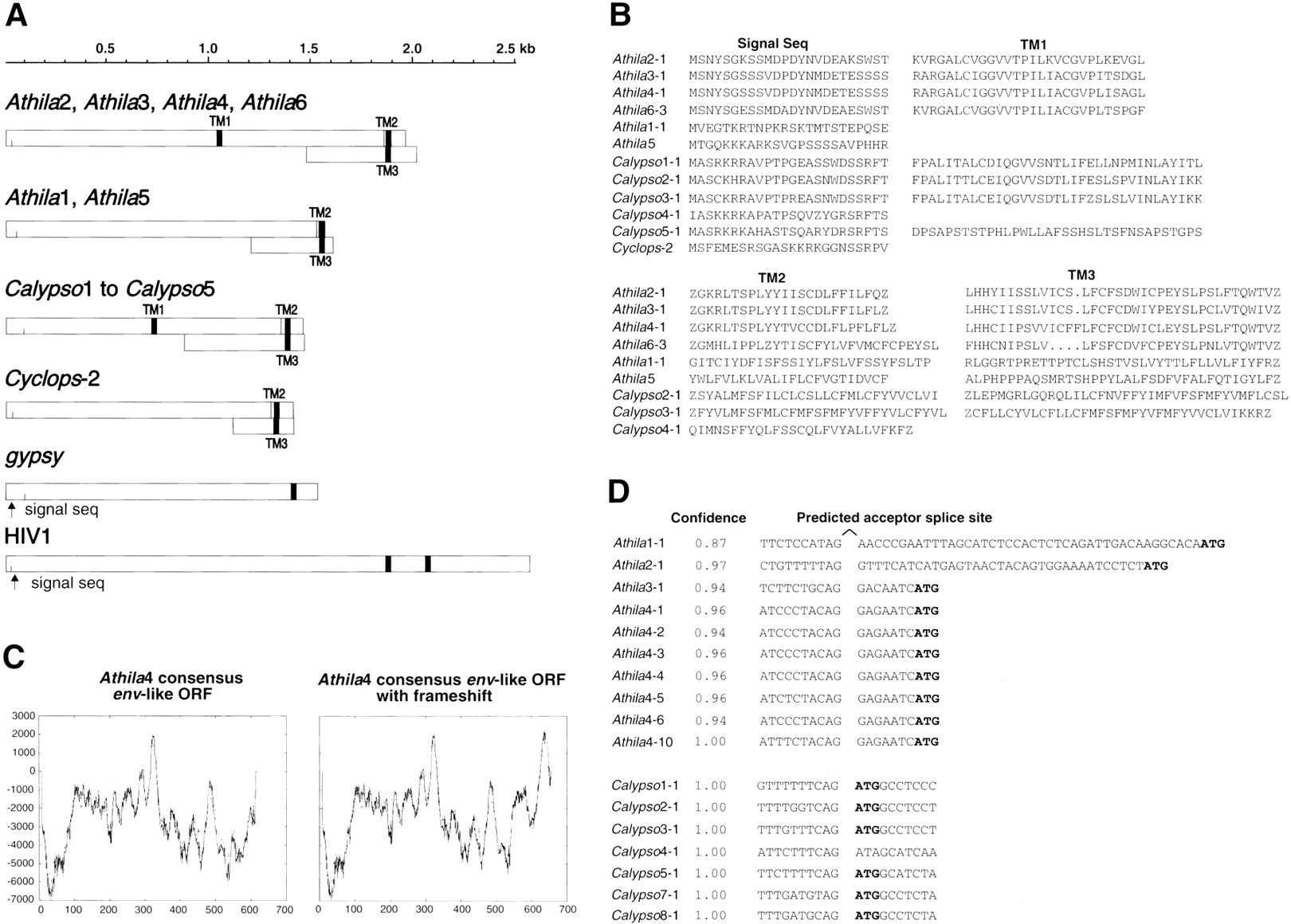
Features of the Athila group env-like ORFs. (A) Generalized organization of env-like ORFs from the Arabidopsis thaliana Athila group elements, the soybean Calypso elements, Cyclops-2 of pea,gypsy of Drosophila melanogaster, and HIV1. The open boxes indicate ORFs. Arrowheads indicate signal sequences. Black boxes indicate transmembrane domains. Vertical lines within boxes denote stop codons. The first methionine within each ORF is indicated by a short line. (B) Amino acid sequences of putative signal sequences at the N termini and predicted transmembrane domains. (C)TMpred output for the Athila4 consensusenvelope (env)-like ORF with and without a frameshift at the C terminus. Values above 500 (on the X-axis) are significant and indicate likely transmembrane domains (Hofmann and Stoffel 1993). The Y-axis indicates amino acid sequence position. (D) Sequences at the putative splice acceptor site of the Arabidopsis thaliana Athila and Calypsoelements. The confidence level indicates the output forNetGene 2 (Brunak et al. 1991; Hebsgaard et al. 1996). The first methionine in the env-like ORF is in bold.