


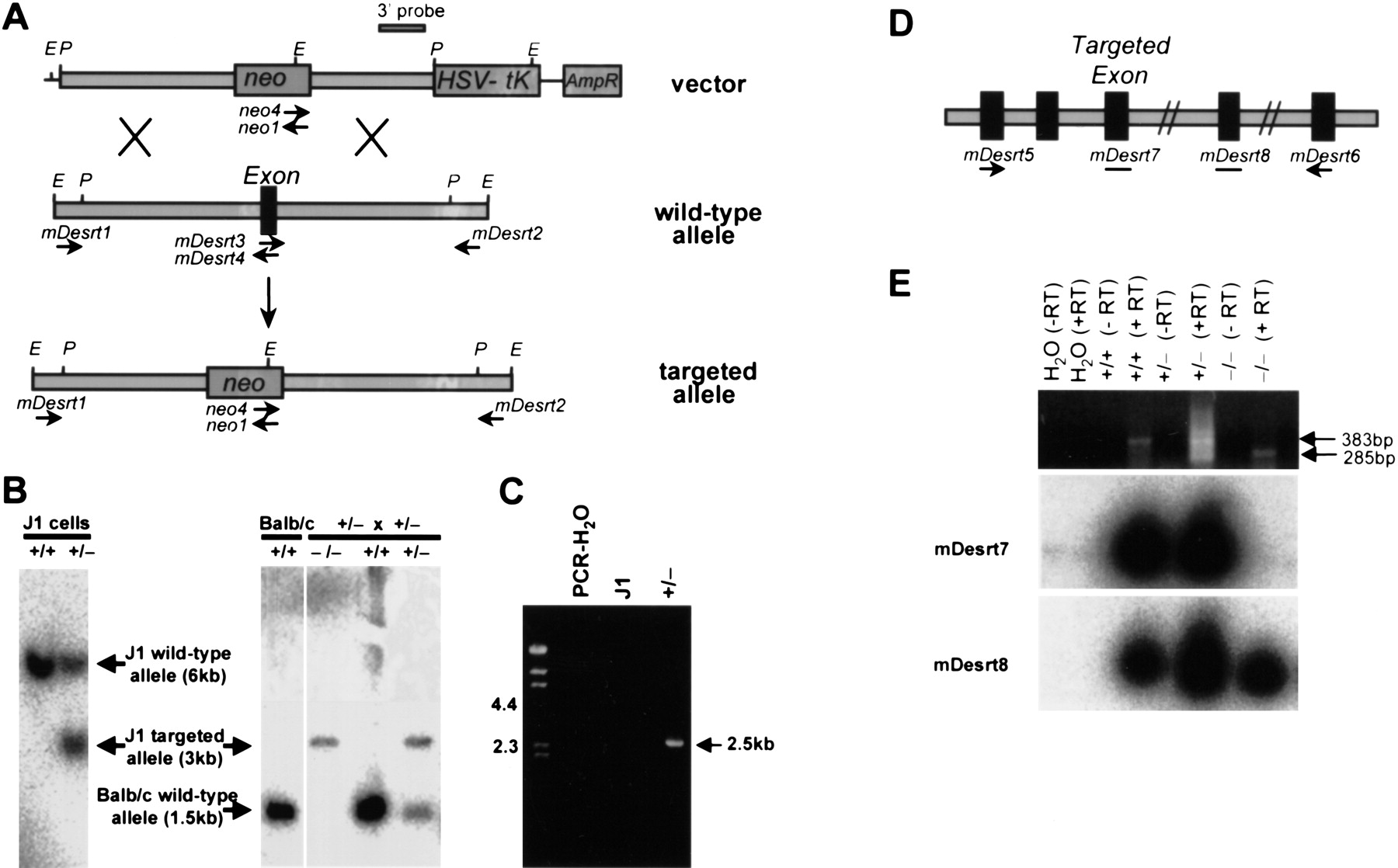
Targeted disruption of the mouse Desrt gene. (A) A schematic representation of a Desrt gene targeting event, showing the positions of EcoRI (E) and PstI (P) sites in the vector, the wild-type allele, and the gene-targeted allele. The position of the 3′ probe and the oligonucleotides used to confirm the targeting of the allele are indicated. (B) A Southern blot analysis of EcoRI-digested genomic DNA isolated from electroporated ES cell clones (left) and mouse genomic DNA (right) hybridized with the 3′ probe. This probe hybridized to a 6-kb EcoRI fragment in the wild-type alleles of unelectroporated J1 ES cells (+/+) and a 3-kb-targeted allele in the heterozygous ES cells (+/−). Progeny of heterozygous matings (+/− × +/−) are shown at right. The 3′ probe hybridized to a 1.5-kb fragment in EcoRI-digested genomic DNA isolated from wild-type (+/+) Balb/c and to a 3-kb targeted allele. (C) PCR analysis of genomic DNA isolated from electroporated ES cell clones by use of oligonucleotide mDesrt2 and a neomycin oligonucleotide, neo4, in the absence of DNA (PCR H2O), in the presence of unelectroporated J1 DNA, or in the presence of DNA isolated from aDesrt-targeted clone (+/−). A 2.5-kb band was detected in the correctly targeted clone. (D) A schematic representation of aDesrt gene fragment showing the positions of the oligonucleotides designed relative to the targeted exon. Exons are depicted as black boxes. (E) RT–PCR of Desrt mRNA expression in +/+, +/−, or −/− primary embryonic fibroblasts. PCR reactions were carried out by use of cDNA samples that had been prepared from total RNA or H2O, in the presence (+ RT) or absence (− RT) of reverse transcriptase. (Top) A 383-bp +/+ fragment, a 285-bp −/− fragment, or both fragments in +/− fibroblasts. Southern blot hybridization of the Desrt PCR reactions was performed by use of mDesrt7, an internal oligonucleotide derived from the targeted exon (middle) or mDesrt8, from a nontargeted exon (bottom). This showed that the PCR-amplified fragments derived from RNA of wild-type or targeted alleles hybridized to internal oligonucleotides derived from the nontargeted exon, whereas the PCR fragments derived from the targeted allele did not hybridize to the internal oligonucleotide derived from the targeted exon.



