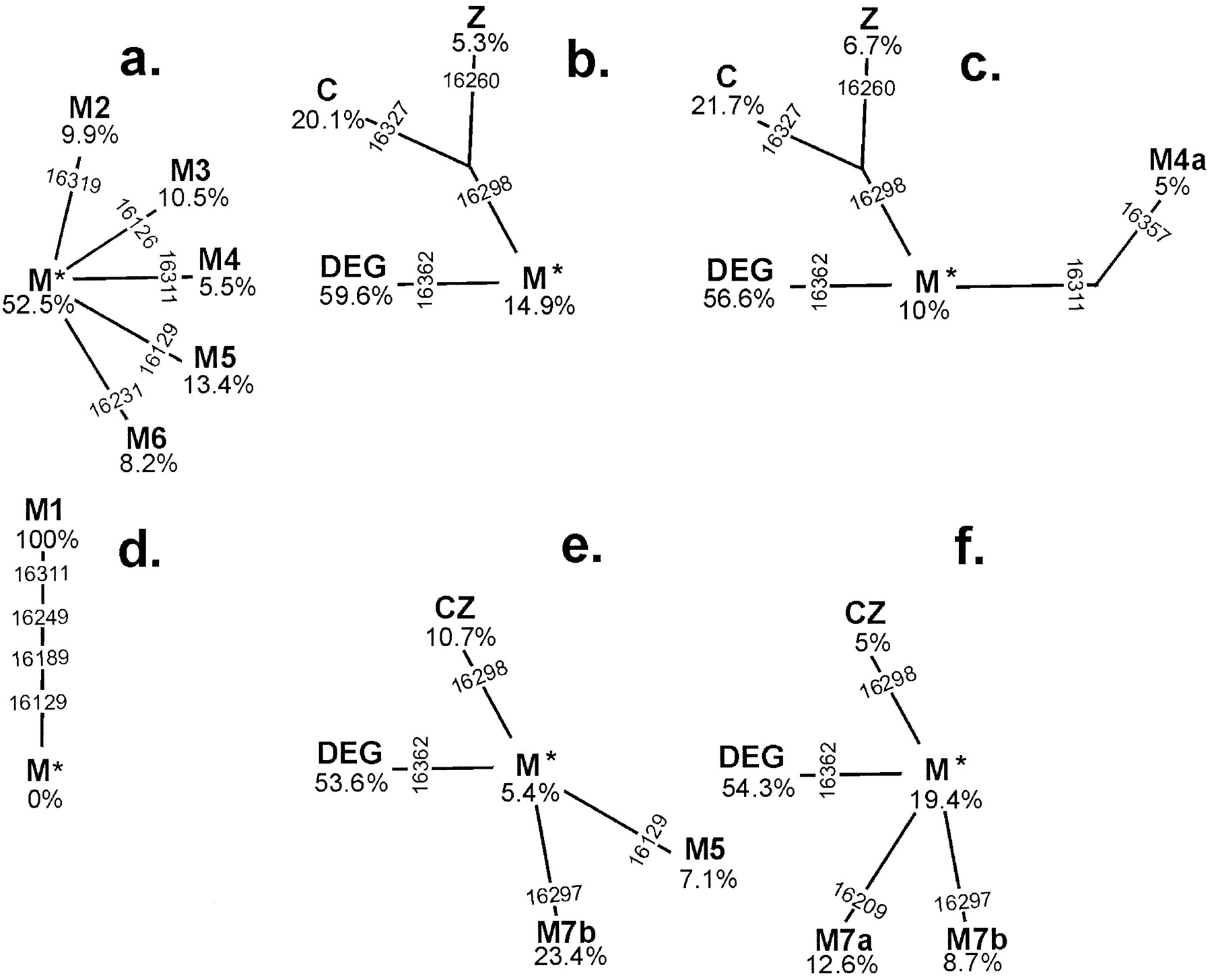
Major subsets of haplogroup M. Phylogenetic relationships of HVR1 haplotypes assigned to haplogroup M were estimated for: (a) 343 Indians (Quintana-Murci et al. 1999a; this study); (b) 16 Turks and 78 Central Asians (Comas et al. 1998; this study); (c) 60 Mongolians (Kolman et al. 1996); (d) 25 Ethiopians (Quintana-Murci et al. 1999a); (e) 56 Chinese (Horai et al. 1996; this study); (f) 103 Japanese (Horai et al. 1996; Seo et al. 1998). The founding node of each network (M*) differs from the CRS (Anderson et al. 1981) by transitions at np 10398, 10400, and 16223. The frequency of each subset of haplogroup M is indicated. Each phylogenetic network was pruned by eliminating branches containing haplotypes summing to a frequency of <5% (these branches were binned with the founder haplotype, M*). The identities of HVR1 mutations (numbered according to the CRS −16,000; Anderson et al. 1981) that define major haplotype subsets are depicted along selected internodes.