



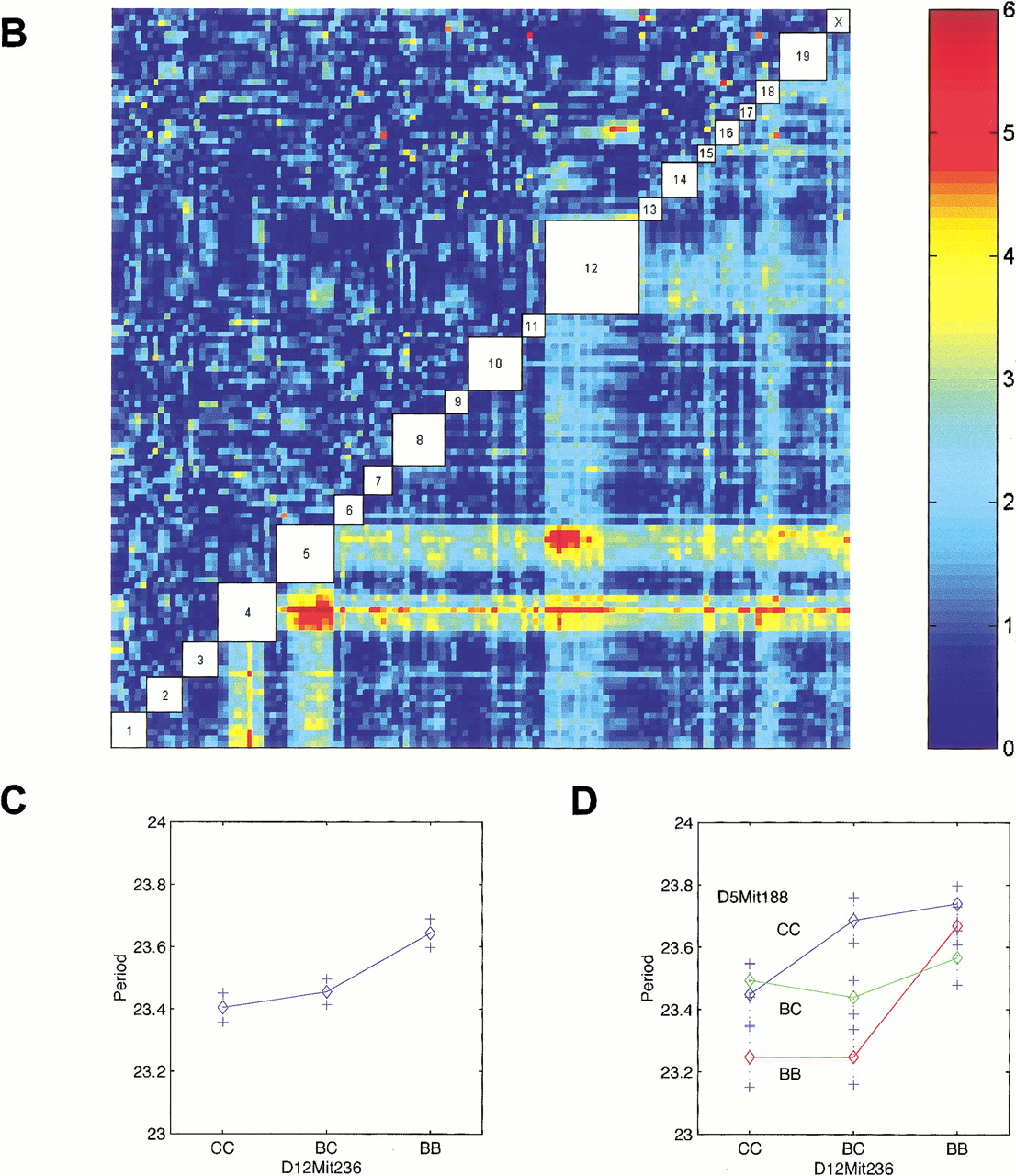
Genome-wide scan for free-running period phenotype. (A) Single marker regression genome scan for free-running period. Thevertical axis is the regression F-statistic (with 2 and n-3 degrees of freedom). Threshold values estimated from 1000 permutations of the trait data are indicated as horizontal lines at genome-wide significance levels of 0.05 and 0.01. The horizontal axis is indexed by the marker loci. Locations of markers are indicated but the relative spacing of the markers is not conserved in the graph. (B) Pairwise marker regression genome scans. The results of the pairwise search for loci associated with free-running period is shown. The x and y axes of the figure are genetic markers arranged in order along the length of the 20 mouse chromosomes. Joint analysis of markers on the same chromosome was not carried out because of numerical problems. Chromosomal locations of the markers are indicated in the empty boxes along the main diagonal of the figure. The color scale indicates the −log10 of the nominalP-value of the F-statistics. The primary scan F-statistic (with 8 and n-9 degree of freedom) is shown below the main diagonal and the secondary F-statistic for interaction (with 4 and n-9 d.f.) is shown above the diagonal. Significant locus pairs identified by the genome scans are listed in Table 3. (C) Main effect ofFrp-3 on free-running period. X-axis represents genotypes at Frp-3 locus. C represents BALB/cJ and B represents C57BL/6J allele. BC represents heterozygote at this locus.Y-axis is free-running period. (D) Pairwise interaction of Frp-2 and Frp-3 on free-running period. X-axis is for genotypes at Frp-2 locus.Y-axis is free-running period. Blue line is CC, green line for BC, and red line for BB at Frp-2 locus.


