


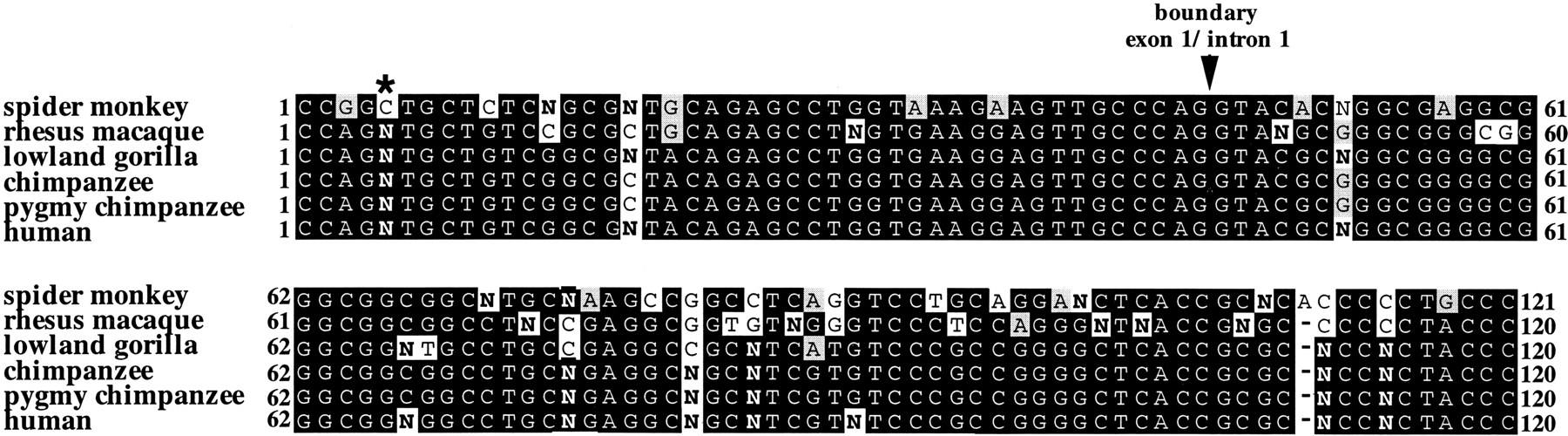
Alignment of DGCR6 primate sequences. The sequences of a 120 bp region from within the larger PCR product amplified from genomic DNA of individual animals with the primers DGCR6–6F/DGCR6–4R are aligned. Six different primate species—spider monkey (an Old World monkey), rhesus macaque (a New World monkey), lowland gorilla, chimpanzee, pigmy chimpanzee, and human—are compared. Represented are the partial exon 1 and intron 1 sequences with the exon/inton boundary denoted by the arrowhead. A two-base assignment to a position within the sequence is denoted by N. A dash (–) indicates a deletion of a base relative to the alignment. The asterisk at position 5 of the sequence denotes the base difference between DGCR6 and DGCR6L used in Figs. 4 and 5.


