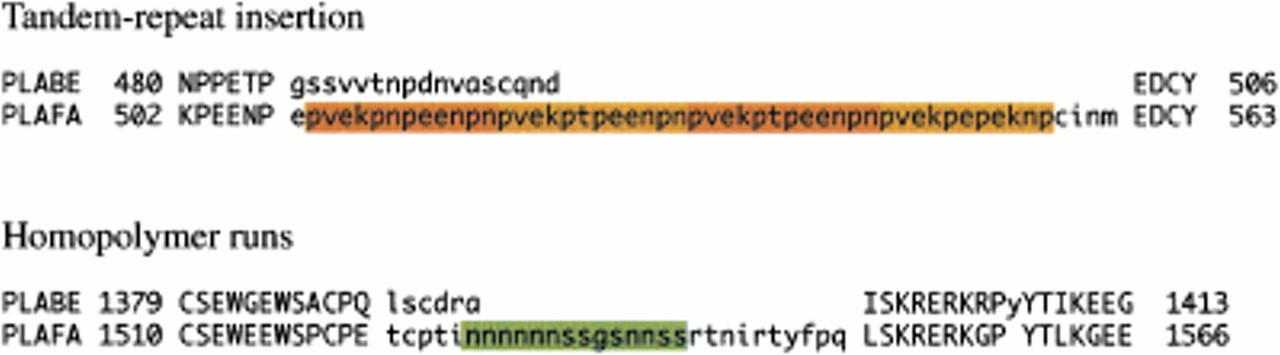
Partial alignment of the ookinete adhesive protein between the Plasmodium falciparum (PLAFA) and the rodent malaria agent Plasmodium berghei (PLABE) sequences, showing two low-complexity elements (lower case, unaligned) between regions of alignment (upper case). The first region includes tandem repeats and the second has homopeptide runs of Asn. Alignment obtained with ITERALIGN (Brocchieri and Karlin 1998). Although multiple alignments are most often used to identify conserved regions of a protein family,Pizzi and Frontali (2001) use it to identify variable regions among homologs. In Plasmodium, variable tandem-repeat regions play a central role in evading the immune system of the host. Do other low-complexity regions have a related function?