


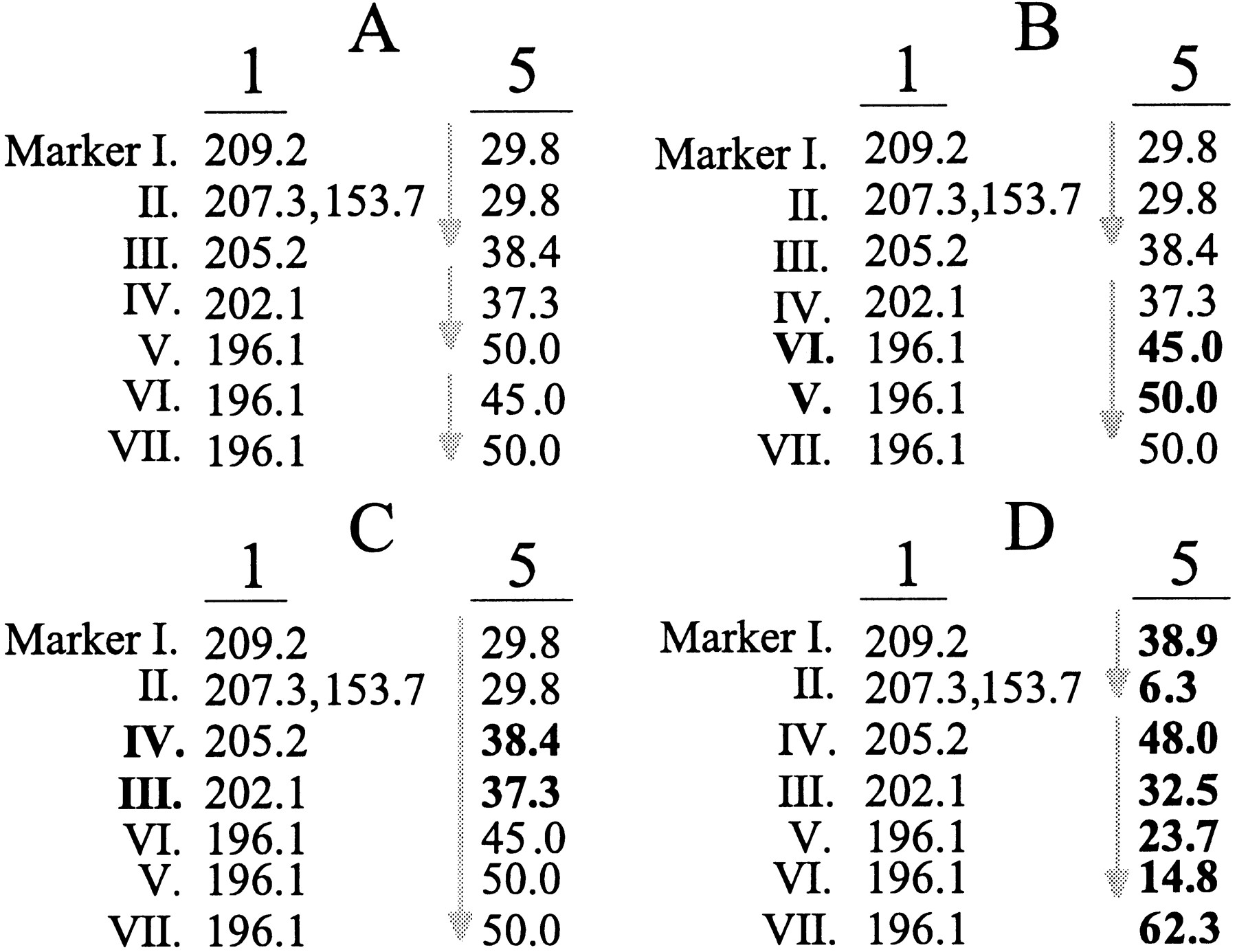
Colinearity based on hypothesized map data from seven markers that cross-hybridize between chromosomes 1 and 5. (A) Marker II hybridizes to two positions on chromosome 1 (153.7 and 207.3 cM). Based on the position of marker II at 207.3 cM, markers I through III define a colinear run of three markers (gray arrow). Some additional colinear runs of n = 2 markers are also shown. (B) Markers V, VI, and VII are binned at 196.1 cM on chromosome 1, and hence their order is ambiguous. Markers VI and V (in boldface) can be rearranged to maximize the number of markers in a colinear run. (C) Maps contain statistical error in the assignment of linear order. If the potential error extends 2.0 cM in either direction of a marker, then the relative position of markers III and IV (in boldface) are uncertain on chromosome 5 because of their close location. A colinear run can extend through these markers in recognition of map error, resulting in a colinear run of seven markers. Recognition of error must be applied to both chromosomes. (D) A simulated data set showing randomized centimorgan locations on tester chromosome 5 (in boldface). The simulated data result in two colinear runs of n = 4 andn = 2 markers (gray arrows).


