


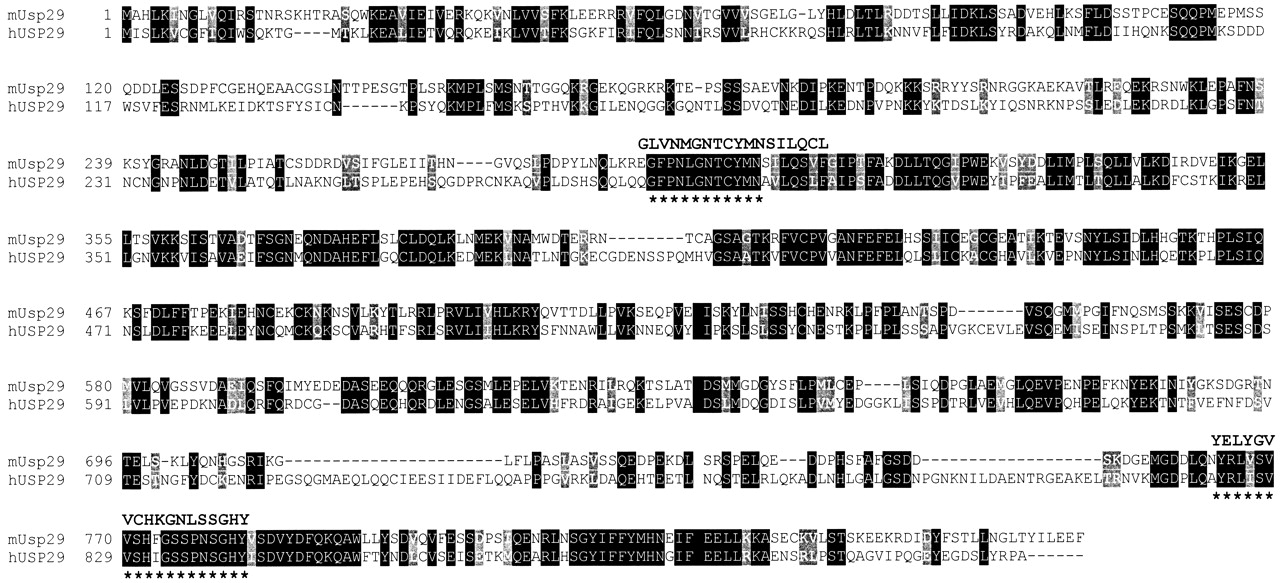
Comparison of mouse and human USP29 amino acid sequences. The upper sequence represents the mouse Usp29and the lower the human USP29 amino acid sequence. Two conserved domains of the type-2 ubiquitin carboxyl-terminal hydrolase family are indicated by asterisks under the amino acid sequence. The consensus sequences of these two domains constructed from the multiple alignment of yeast sequences are also presented and compared with the sequence alignment of human and mouse USP29. Sequence identity (black background) and conservative substitution with similar properties (gray background) are indicated. The two sequences are aligned for maximal match by the SIM program (http://dot.imgen.bcm.tmc.edu:9331/seq-search/alignment.html).



