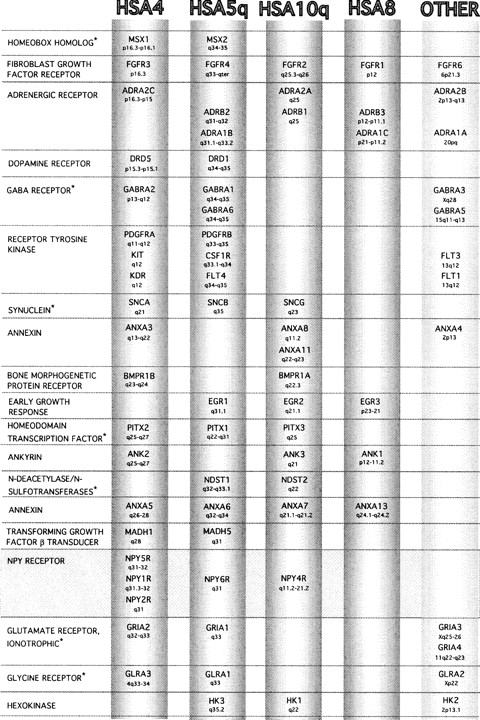
Gene families with members localized on HSA4, HSA5q, and HSA10q forming part of three paralogous chromosomal groups. Another paralogous region is implicated on HSA8, along with several genes localizing to “other” chromosomes, but not forming a large cluster. The asterisk (*) indicates that we did not find a reference phylogenetic tree for this gene family; for the other gene families the following references were used: hexokinase (Cardenas et al. 1998); ankyrins (Pebusque et al. 1998); dopamine receptors (Fryxell 1995; Cardinaud et al. 1997); annexins (Morgan et al. 1998); adrenergic receptors (Fryxell 1995); BMP receptors and TGF-β signal transducers (Newfeld et al. 1999); glycine receptors (David-Watine et al. 1999); receptor tyrosine kinases (Rousset et al. 1995); FGF receptors (Coulier et al. 1997); EGFs (Hughes 1999). The gene order is according to that on HSA4 and is not always the same for the other chromosomes. Data were taken from the Genome Database (http://gdbwww.gdb.org/) and OMIM (http://www.ncbi.nlm.nih.gov/Omim/).The first listed genomic localization was used if multiple localizations had been made, or the HUGO approved localization. (Please note that NPY4R is designated as PPYR1 by HUGO.)