


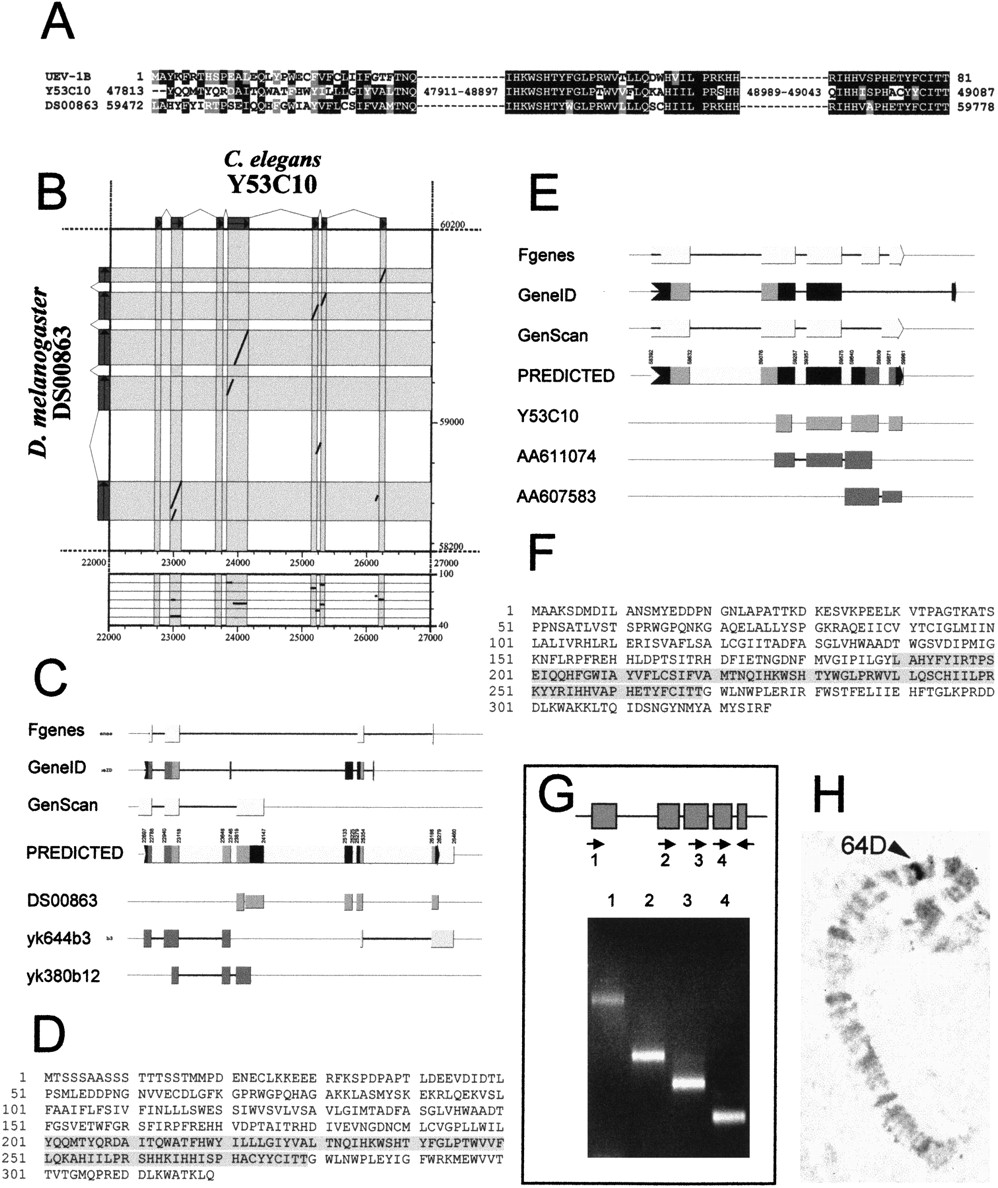
A new gene in Caenorhabditus elegans and Drosophila melanogaster coding for B domain-like sequences. (A) Alignment of the human UEV1 B domain with TBLASTN-identified segments from C. elegans Y53C10 and D. melanogaster DS00863 genomic clones. The aligned segments are discontinuous in Y53C10, as indicated by the positions of nucleotides from the database entry. (B) Dot-plot analysis of reciprocal TBLASTX comparisons of genomic clones Y53C10-B (C. elegans) and DS00863-B (D. melanogaster). (Bottom) Scores of sequence identities for each diagonal of conserved segments, shown as horizontal bars. (C) Predicted structure of the new gene in C. elegans(middle) supported by gene prediction algorithms (top) and alignment with ESTs (bottom). (D) Predicted C. elegans protein containing a B domain-like segment (shaded). (E) Predicted structure of the new gene inD. melanogaster (middle), supported by gene prediction algorithms (top) and alignment with ESTs (bottom). (F) Predicted D. melanogasterprotein containing a B domain-like segment (shaded). (G) Expression analysis by RT–PCR, with forward primers corresponding to exons 1, 2, 3, and 4 of the predicted gene, and a reverse primer corresponding to exon 5, using as templates embryo mRNAs. (H) Cytogenetic assignment of D. melanogaster UEV gene to chromosome 3 segment 64D. Digoxigenin-labeled cDNA probes were used for hybridization on wild-type Drosophila polytene chromosomes.


