


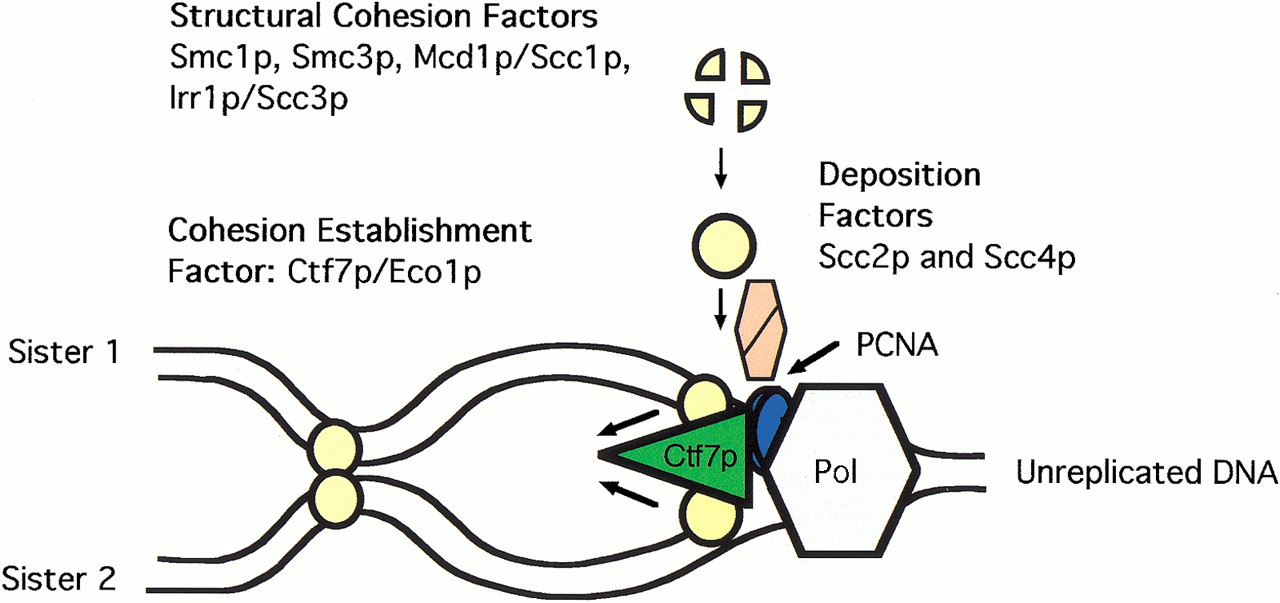
One possible mode of action for cohesion establishment. Structural cohesion factors Mcd1p/Scc1p, Irr1p/Scc3p, Smc1p, and Smc3p (yellow balls) are loaded as a complex or by stepwise addition onto chromatin via the Scc2p-Scc4p deposition complex (salmon rectangle). Deposition is shown to occur near the site of action of Ctf7p, but may occur anywhere before or after the replication fork. Establishment of sister chromatid cohesion requires Ctf7p/Eco1p (green triangle), which may move in association with PCNA at the DNA replication fork. Ctf8p, Ctf4p/Chl15p/Pob1p, Chl12p/Ctf18p, and the DNA polymerase Trf4p (Pol κ) are other cohesion factors that may associate with the DNA replication fork (not shown).



