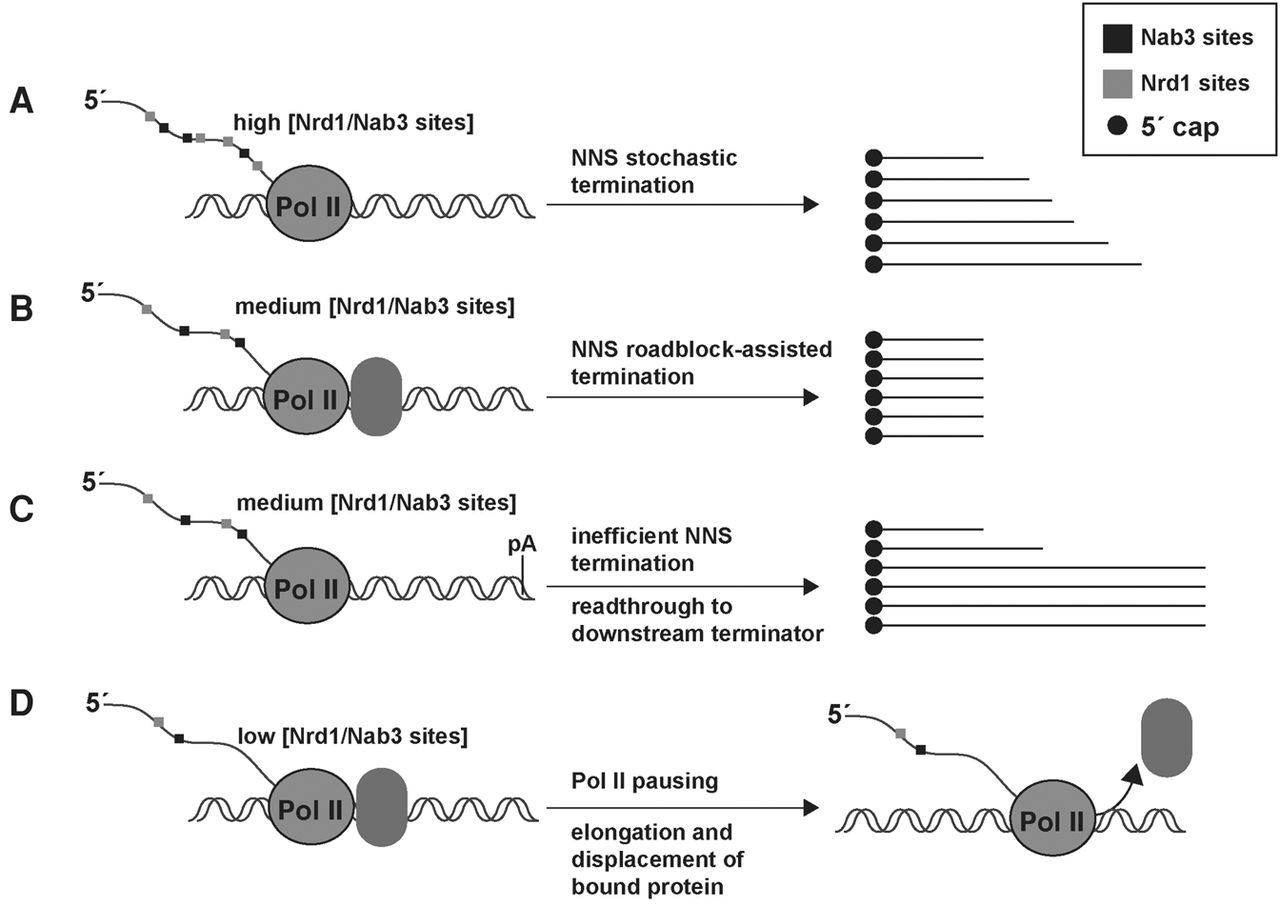
Model for the control of Pol II elongation and DNA-binding protein dynamics by the NNS pathway. (A) In the presence of a high concentration of Nrd1p and Nab3p binding sites in the nascent RNA and in the absence of obstacles in the template, Pol II will undergo termination in a stochastic manner over a broad genomic window, resulting in highly heterogeneous 3′-ends with a preference toward nucleosome edges. (B) In the presence of medium (or high) levels of Nrd1p and Nab3p binding sites and a downstream DNA-binding protein (e.g., GRF, Pol III unit; oval), Pol II will undergo termination at a defined position dictated by the collision of Pol II with the DNA-binding protein and produce a homogenous set of RNA 3′-ends. (C) In the presence of medium levels of Nrd1p and Nab3p binding sites and the lack of any downstream DNA-binding protein, Pol II will undergo inefficient NNS termination and continue reading through until encountering a downstream terminator. In this example, a downstream CPA site is utilized. (D) In the presence of low levels of Nrd1p and Nab3p binding sites and a downstream DNA-binding factor, Pol II will elongate through the binding site, displacing the DNA-bound protein (oval) from the template.