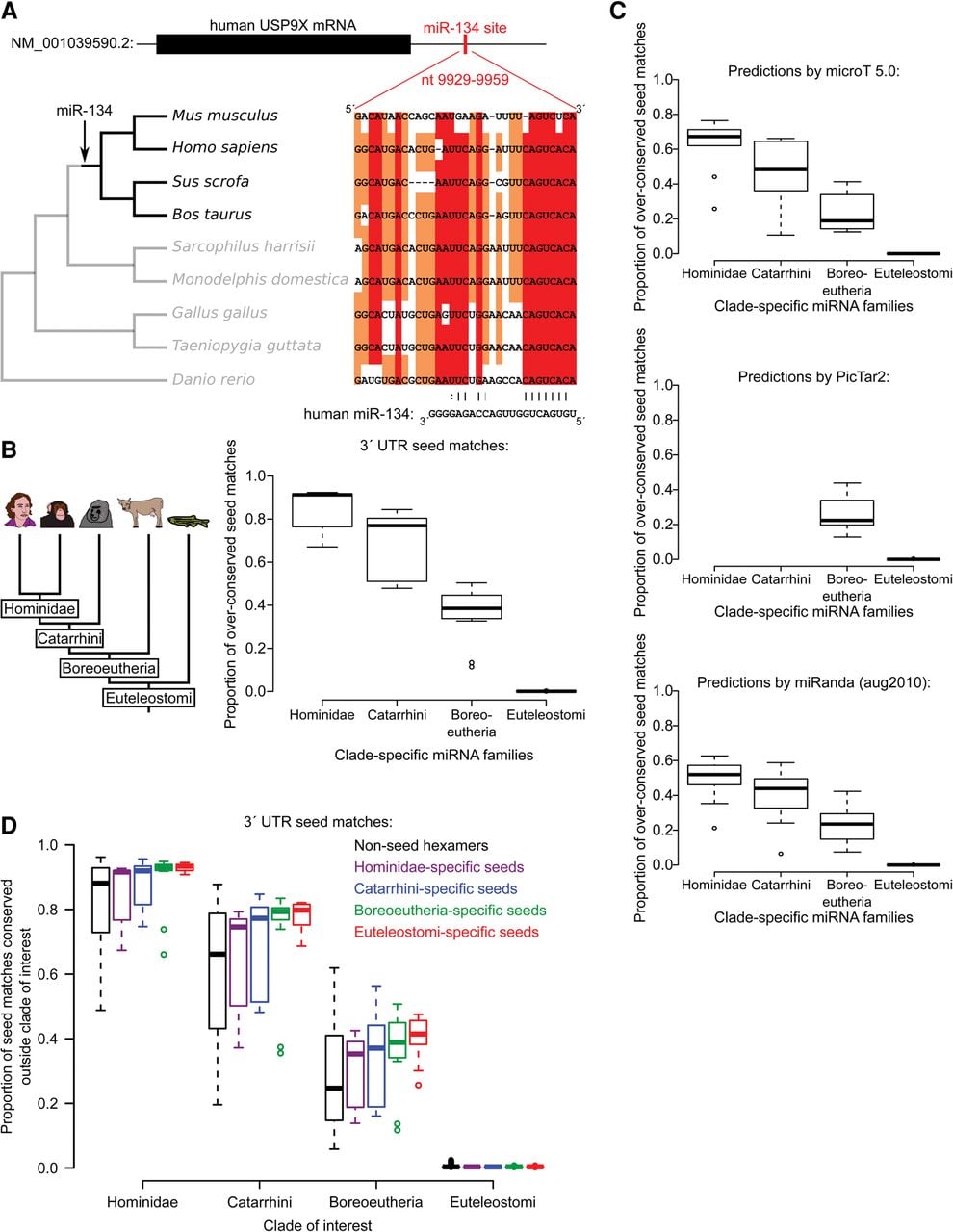
Computationally identified conserved seed matches are frequently more conserved than miRNA seeds themselves. (A) The miR-134 family is specific to placental mammals, but its predicted binding site in USP9X is more broadly conserved. (B) Four vertebrate clades had enough clade-specific miRNA families for a detailed statistical analysis (10 Hominidae-specific families, 14 Catarrhini-specific families, 14 Boreoeutheria-specific families, 10 Euteolostomi-specific families) (see Supplemental Fig. S7). Each point in the boxplot represents an miRNA seed family. The proportion of overconserved 3′ UTR seed matches is defined as the fraction of matches that are conserved in at least one species outside the clade of interest. (C) Proportion of overconserved seed matches among the predictions of several miRNA target prediction programs. Note that PicTar2 ignores Hominidae- and Catarrhini-specific miRNAs, while TargetScan predicts and ranks targets of mammalian-specific miRNAs without using phylogenetic conservation. In order to make every program output comparable, analyses were restricted to perfect seed matches in 3′ UTRs, excluding matches that overlap exon–exon junctions (see Supplemental Table S5 for detailed statistics). (D) 3′ UTR seed matches were analyzed as in panel B, but each group of clade-specific seeds was scored for conserved seed matches outside each of the four clades. Nonseed hexamers (i.e., hexamers that do not constitute the seed of any vertebrate miRNA in miRBase 21) were analyzed identically.