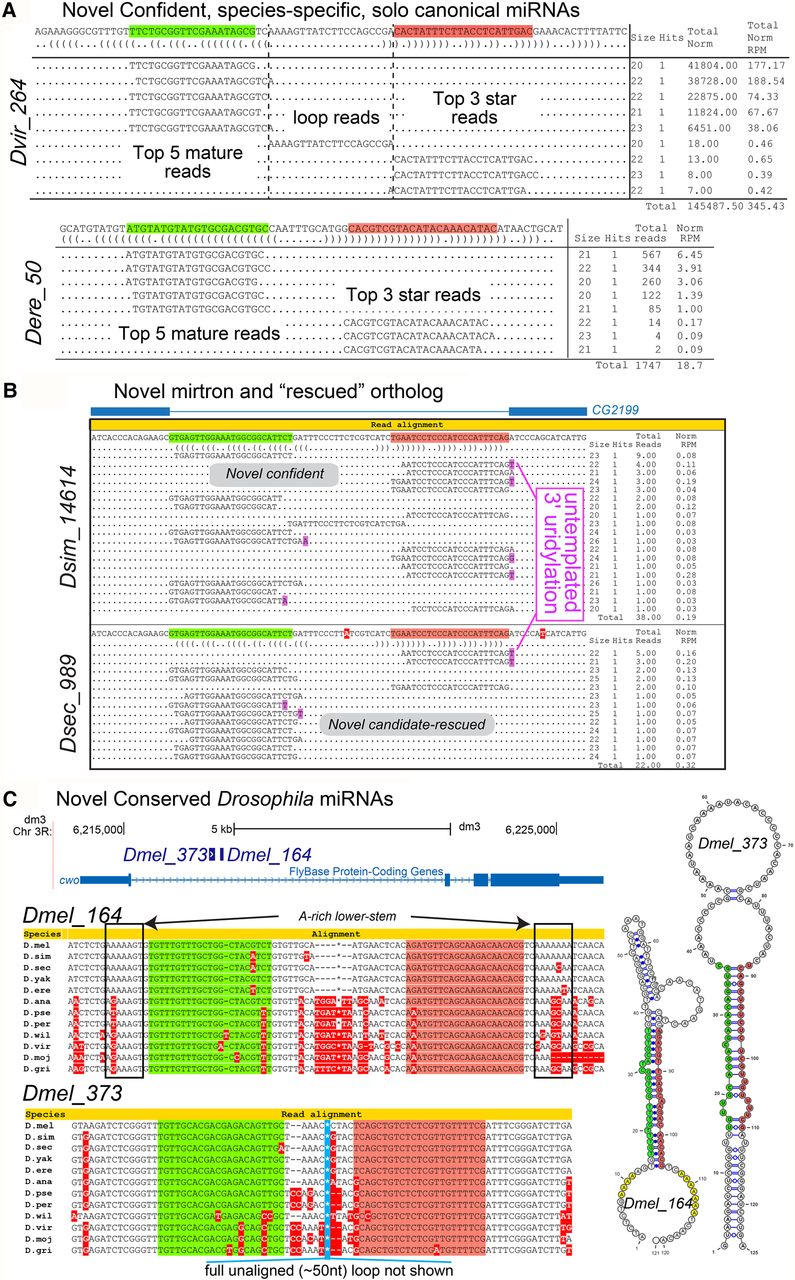
Examples of novel miRNAs identified in this study. (A) Dvir_264 and Dere_50 are examples of confident, canonical miRNAs. Small RNAs were cloned from both arms of their pre-miRNA, and an alignment of these sequences reveal patterns of precise 5′ end cleavage and 1- to 2-nt 3′ blunt end overhang in the hairpin structure. These are all signatures of Drosha- and Dicer-mediated cleavage. (B) Examples of orthologous confident (Dsim_14614) and candidate-rescued (Dsec_989) mirtrons within the two sister species, D. simulans and D. sechellia. Total cloned reads for Dsec_989 fell below our threshold for “confident” classification, and this mirtron was effectively placed into the “candidate” confidence group. We “rescued” this locus due to its synteny with Dsim_14614, a confident mirtron. (C) Two novel, conserved, canonical miRNAs identified within the host gene cwo. Dmel_164 sequence alignment indicates higher conservation of the miR and miR* arms in comparison to the loop and flanking basal stem regions, a classic signature of pre-miRNA sequence conservation. However, it possesses conserved A-rich regions that flank the duplex, which are seemingly incompatible with a lower stem needed for Drosha processing. Dmel_373 exhibits a large terminal loop atypical of most canonical miRNAs. The full alignments of Dmel_373 loops across Drosophila species can be accessed in the Supplemental Material. (RPM) Reads per Million mapped reads.