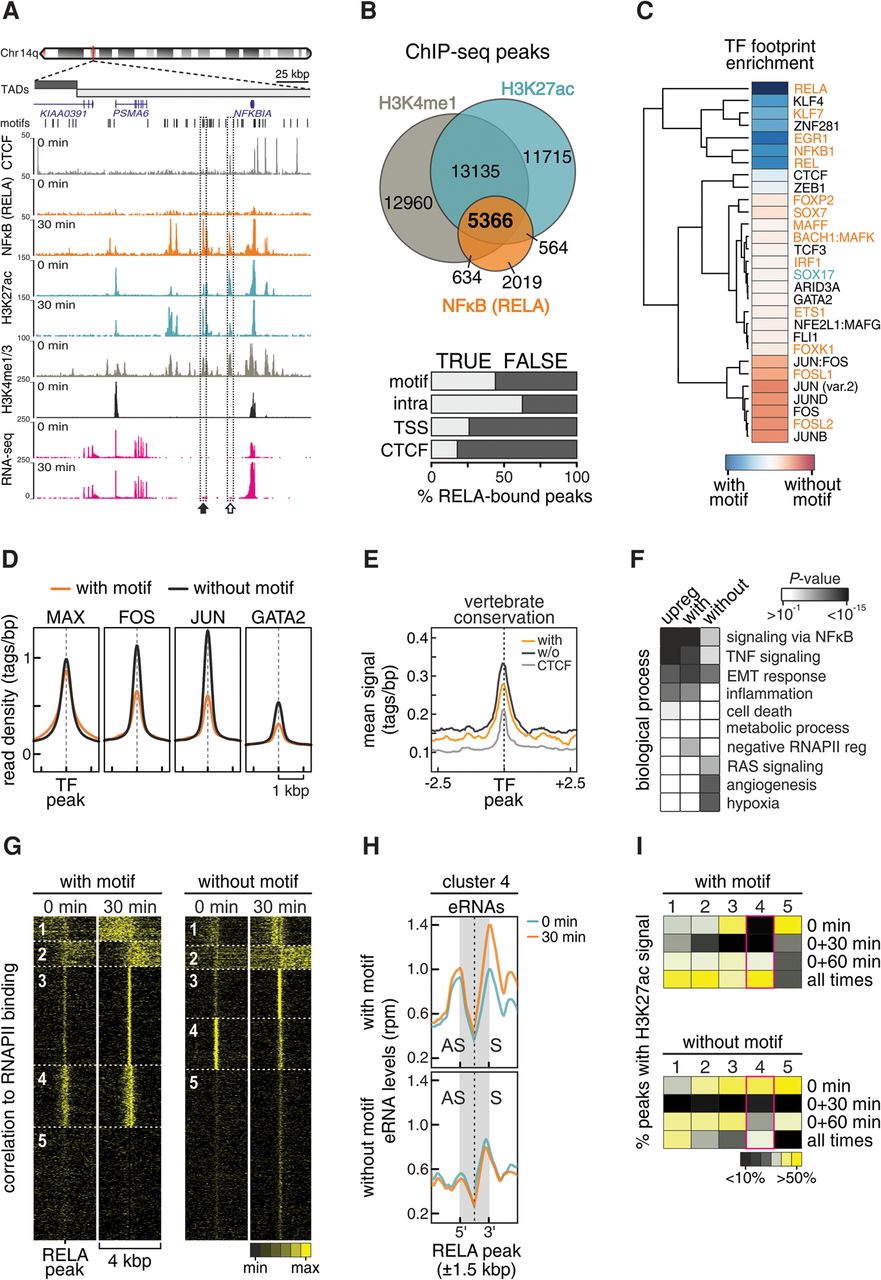
RELA binds already-active enhancers “with” or “without” a canonical binding motif. HUVECs were treated with TNF for 0 or 30 min and NF-κB binding assessed (via RELA ChIP-seq). (A) ChIP- and RNA-seq coverage (reads per million) of the responsive NFKBIA locus; “motifs” refers to canonical NF-κB binding motifs. Closed and open arrows (bottom): a RELA peak overlapping a canonical and a noncanonical recognition motif, respectively. (B) (Top) The overlap between 0-min H3K4me1 (gray), H3K27ac (teal), and 30-min RELA (orange) ChIP-seq peaks; 5366 peaks are bound by RELA at 30 min. (Bottom) Percent RELA-bound peaks that carry (or not) the canonical motif, are intragenic, or overlap a TSS or a CTCF peak. (C) Relative enrichment of transcription factor (TF) binding motifs in DNase-hypersensitive footprints around “with” (blue) or “without” (red) canonical RELA binding motifs. TFs induced or repressed by TNF are colored orange and blue, respectively. (D) Occupancy (read tags per bp) for MAX, FOS, JUN, and GATA2 ChIP-seq in the 2 kbp around RELA peaks “with” (orange) or “without” (black) canonical motifs. (E) Conservation (among 17 vertebrates) in the 5 kbp around “with”/”without” RELA or CTCF peaks. (F) The most significantly enriched GO terms (biological process) associated with genes assigned to 30-min RELA peaks “with”/”without” motifs in the same TAD; GO terms for up-regulated genes are shown for comparison. Note that any gene linked to both “with” and “without” peaks is classified as “with.” (G) Heat maps illustrating RNAPII signal (grouped hierarchically into five clusters) in the 4 kbp around RELA peaks “with”/”without” motifs. (H) Changes in eRNAs levels (data from Caudron-Herger et al. 2015) around RELA peaks from “with” (top) and “without” (bottom) cluster 4. (AS) Antisense-strand signal, (S) sense-strand signal. (I) The fraction of RELA peaks per cluster (as in G) overlapping H3K27ac peaks at the different times.