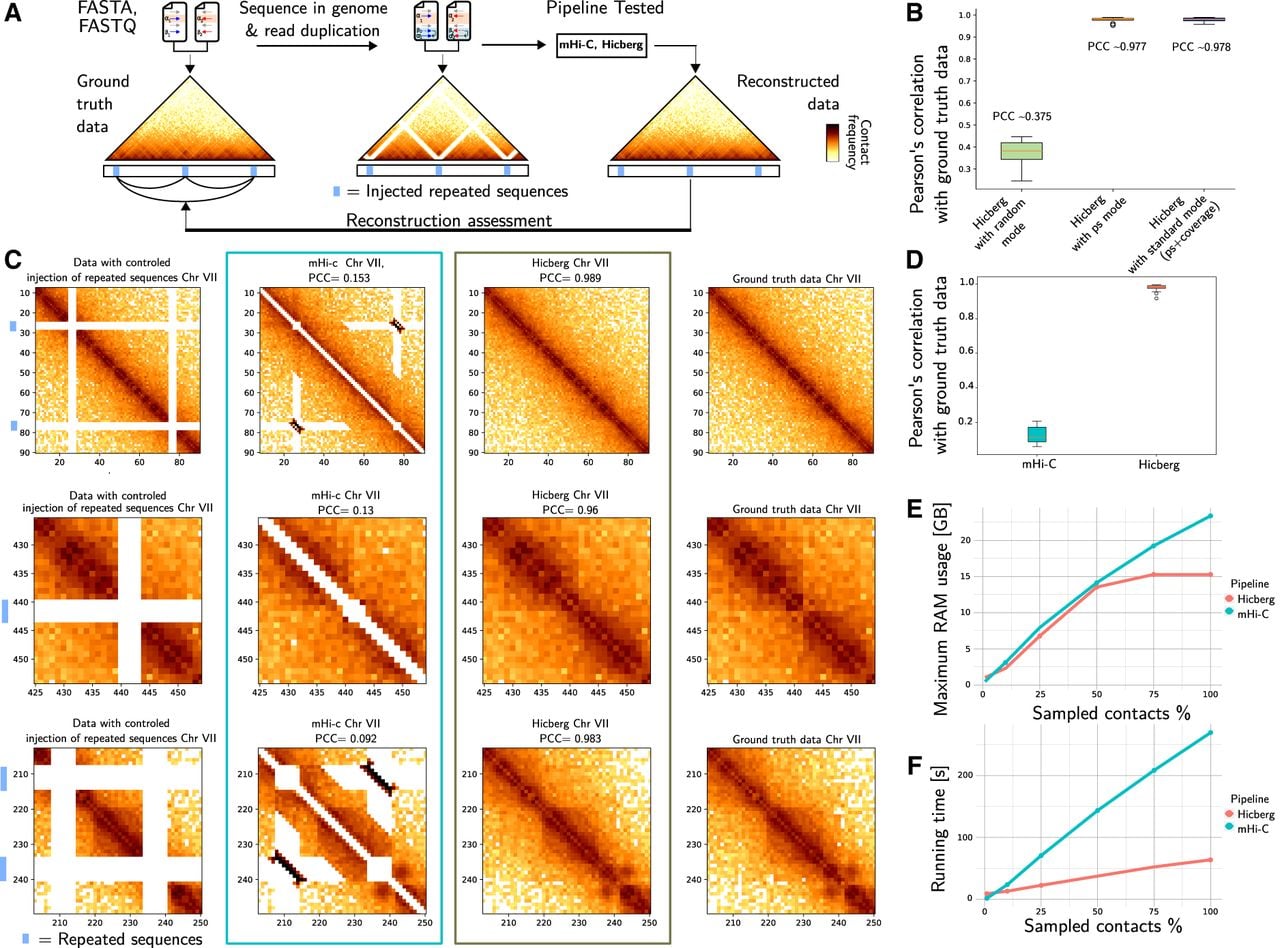
In silico bench testing strategy for assessing the quality of Hicberg reconstructions. (A) Controlled ambiguity is injected by duplicating sequences and selected reads in the FASTA and FASTQ files at chosen positions. This ambiguity is then confronted with Hicberg reconstruction after profiling and statistical inference. The ground truth and the data reconstructed through Hicberg are compared to assess the quality of the proposed reconstruction via the Pearson's correlation coefficient (PCC). (B) Comparison of the Hicberg method with three different modes of determination of contact probabilities: random mode (uniform distribution between the different contacts) and P(s) mode using the frequency of contact in function of genomic distance, with standard mode using in addition the genomic coverage. (C) Comparison of the mHi-C and Hicberg methods evaluated using the benchmark shown for three different representative regions: from left to right; contact map from data with controlled injection of repeated elements (blue boxes), with data reconstructed with mHi-C, with data reconstructed with Hicberg, and from ground-truth data. PCCs with the ground-truth data are given for mHi-C and Hicberg reconstructions. (D) Comparison of the mHi-C and Hicberg methods evaluated using the benchmark. The box plot shows the distribution of 24 comparisons using the PCC between the reconstructed region and the same region derived from the ground-truth data. (E) Memory usage of both Hicberg and mHi-C according to the subsampling of Hi-C data of S. cerevisiae from 5% to 100% of the 47 million pairs of reads of the data. (F) Runtime of both Hicberg and mHi-C according to the subsampling of Hi-C data of S. cerevisiae from 5% to 100% of the 47 million pairs of reads in the data.