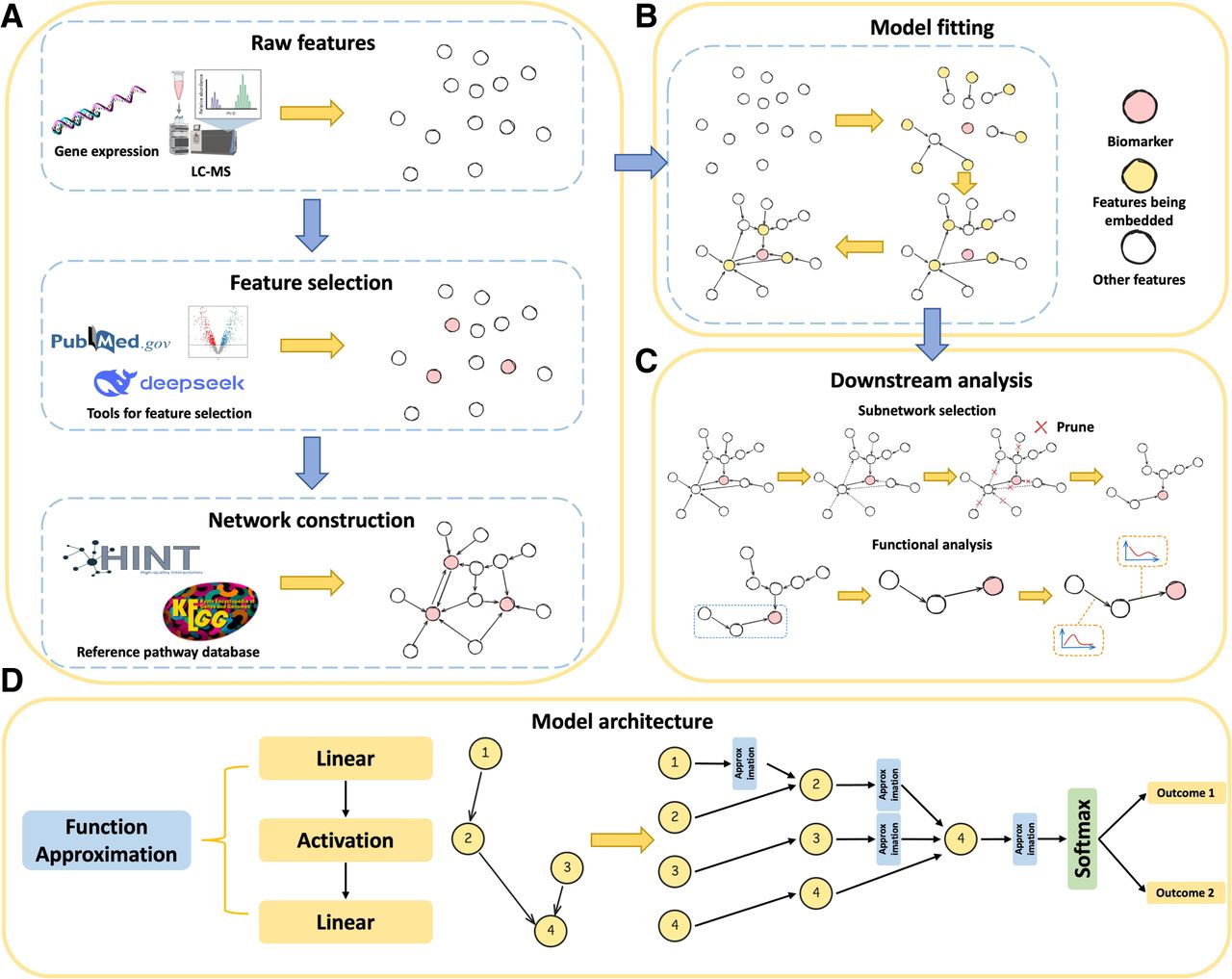
Overview of the PathNet workflow and model architecture. (A) Raw molecular features are acquired from omic platforms such as gene-expression profiling and LC–MS; candidate centric features are selected using biological knowledge and data-driven evidence; and pathway or interaction databases are used to construct the local prior graph around those centric features. (B) During model fitting, pathway-connected neighboring features are embedded toward selected biomarker/centric features through sparse graph-constrained connections, whereas unrelated features are excluded from the corresponding local propagation route. (C) After training, retained edge functions are used for downstream analysis, including subnetwork selection by pruning weak connections and functional analysis of learned edge-specific response curves. (D) The model architecture uses edge-specific functional approximation blocks and a sparse feed-forward propagation structure before the final softmax prediction layer.