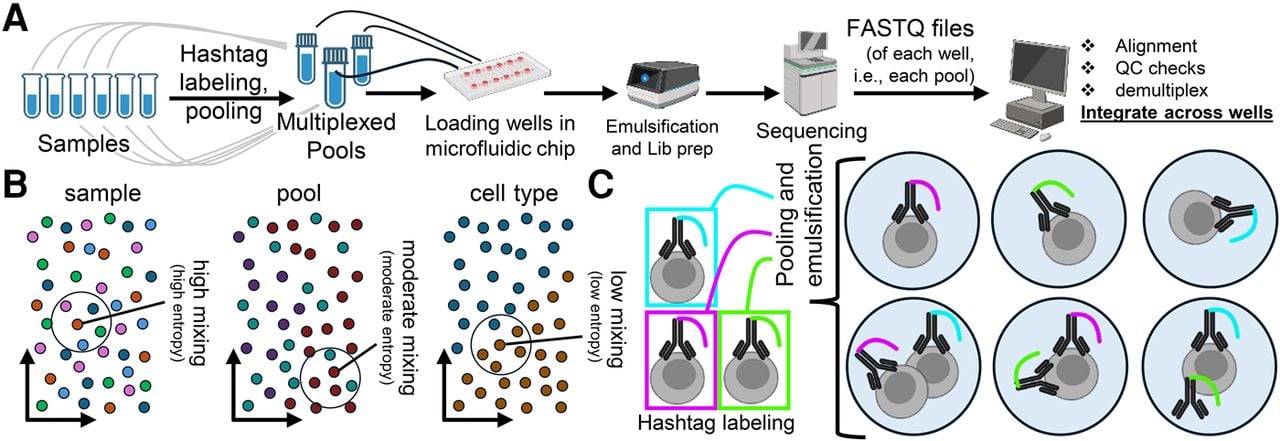
A cartoon overview of a typical single-cell experiment, estimation of batch effects and hashtag labeling. (A) Overview of an in-house, single-day, scRNA-seq experiment in a laboratory. Samples are labeled with hashtags and combined for multiplexing. Each multiplexed pool is loaded into separate wells on a microfluidic plate (e.g., 10x Genomics chips) for droplet capture and reaction. The libraries are sequenced, and reads from each well (i.e., the pool) are separated based on the indexes they receive during library preparation. FASTQ files are then taken through the computational pipelines of alignment, quality control, demultiplexing, etc. Finally, the data from all the wells in that experiment are integrated to mitigate batch effects. (B) In scRNA-seq data analysis pipelines, the cells are projected in lower-dimensional spaces (e.g., principal component space or further corrected integrated spaces) based on their transcriptome. Generally, 30–50 dimensions are used, but in the cartoon shown here, a two-dimensional space is depicted for illustration. Each cell can have different attributes, also known as metadata, as depicted by different colors here within each subplot: sample (left), pool (middle), cell type (right), etc. In the absence of batch effects, similar cells from different pools and samples will be well mixed in this space, because they will not have batch-related differences in their gene expression other than biologically relevant differences. The lower the batch effects, the higher the diversity of a cell's neighborhood and the larger the entropy of that cell for those particular metadata. Typically, cell-type metadata have low mixing compared with those of samples and pools, because cells of the same type are expected to remain together in the reduction space. (C) A cartoon of emulsion droplets with hashtag-labeled cells. Generally, they are individual cells with one predominant hashtag (top circles). In some cases, more than one cell can be in a droplet (left bottom circle). Or one cell may be labeled by more than one hashtag owing to ambient hashtag antibodies after pooling (middle bottom). Alternatively, the emulsification process might capture free antibodies in the medium (right bottom). This figure is created with BioRender (https://www.biorender.com).