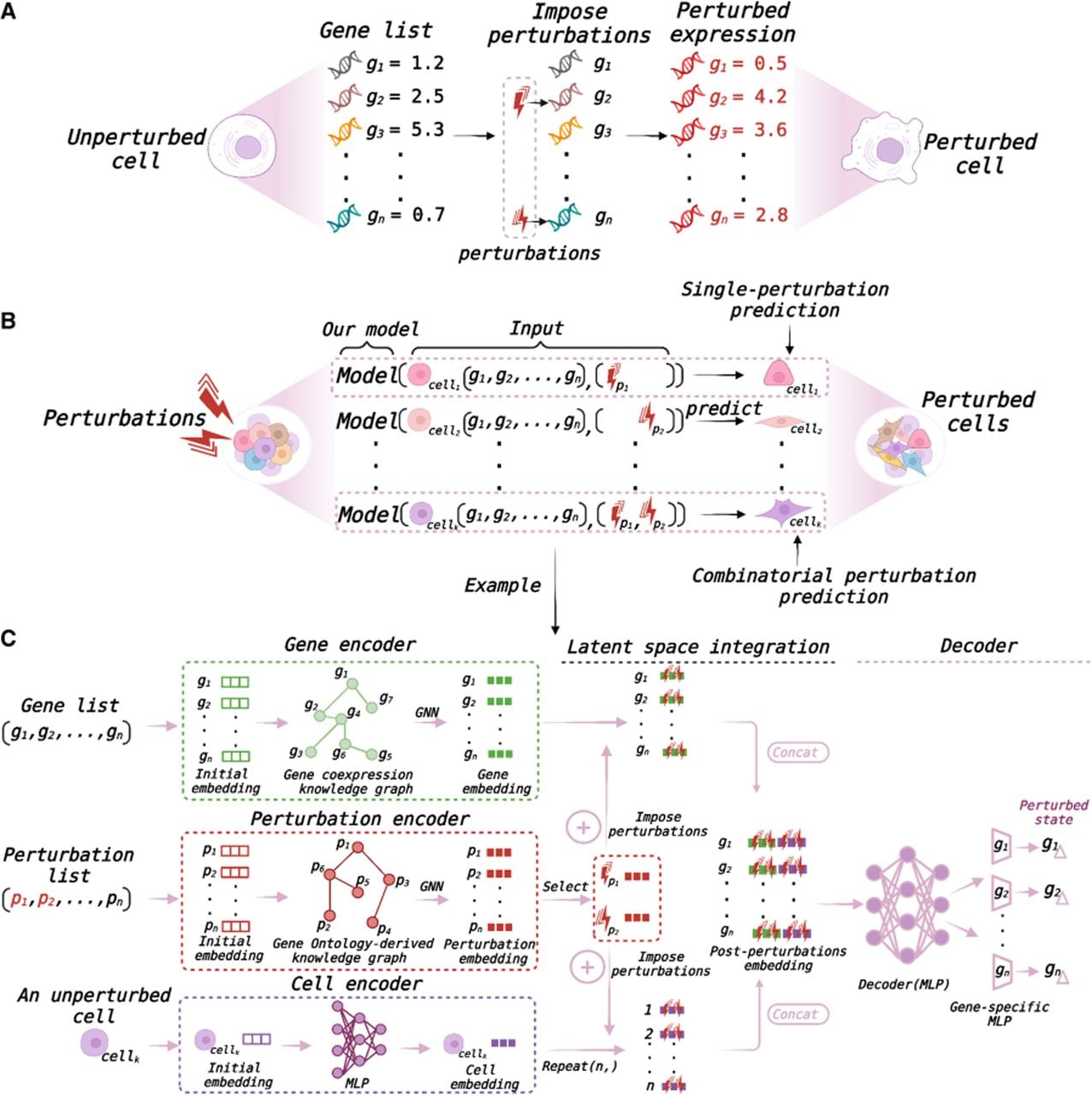
Incorporating valuable prior knowledge to predict postperturbation gene expression. (A) Demonstration of the perturbation process. One or more genes from the gene list of unperturbed cells are selected for perturbation, and the expression of all genes is observed in the postperturbation state. (B) PRIM is capable of predicting both single-perturbation and combinatorial-perturbation responses. The inputs to PRIM mainly include the gene list, the set of perturbation conditions, and the unperturbed cells. (C) Schematic diagram of PRIM framework for predicting combinatorial perturbation responses. The gene list, perturbation conditions, and unperturbed cell are encoded separately, and the resulting representations are integrated in the latent space to obtain the postperturbation embedding. This embedding is then decoded by two distinct MLP decoders to yield the final predicted postperturbation expression changes of each gene. ⊕ indicates the sum operation; concat, for the concatenation.