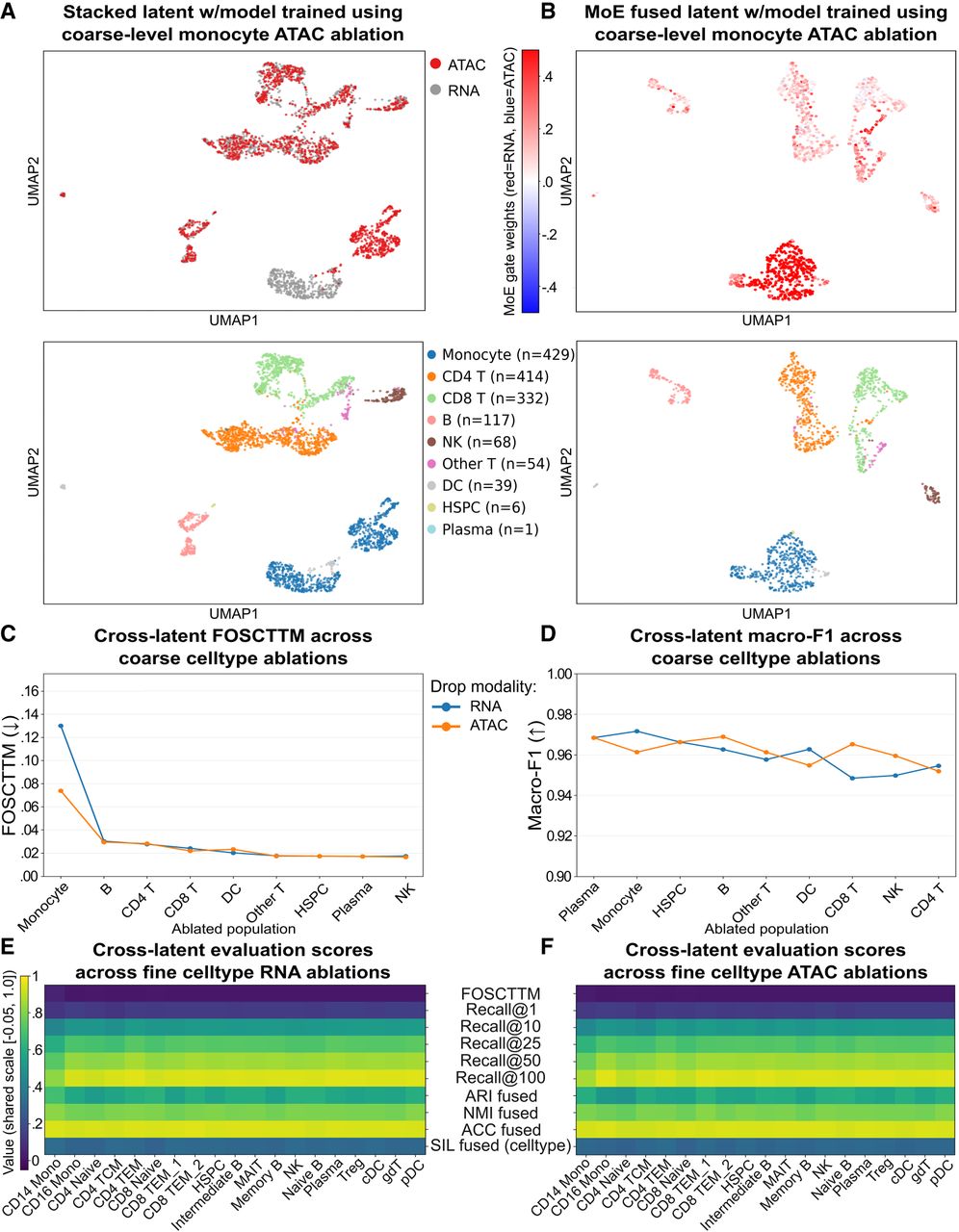
Cell type–specific modality dropout reveals localized degradation and interpretable MoE behavior. Paired 10x Genomics Multiome PBMCs were subjected to targeted modality ablation in which one modality (RNA or ATAC) was masked only for a single annotated population during training; evaluation was performed on unchanged paired validation/test splits (Supplemental Methods). (A) Stacked latent UMAP colored by modality for an illustrative ablation condition, showing that the perturbation is localized while global geometry is preserved. (B) MoE fused-latent UMAP colored by signed gating preference (e.g., wRNA − wATAC), highlighting a localized shift toward the remaining modality within the ablated region. (C) Coarse-label summary of correspondence degradation under targeted dropout, quantified on paired test embeddings (e.g., FOSCTTM; lower is better), comparing RNA-drop versus ATAC-drop conditions across ablated populations. (D) Coarse-label summary of semantic stability under targeted dropout (cross-modality label transfer macro-F1; higher is better). (E,F) Fine cell type heatmaps summarizing correspondence and clustering diagnostics across all evaluated populations for (E) RNA-drop and (F) ATAC-drop conditions (metrics indicated per row).