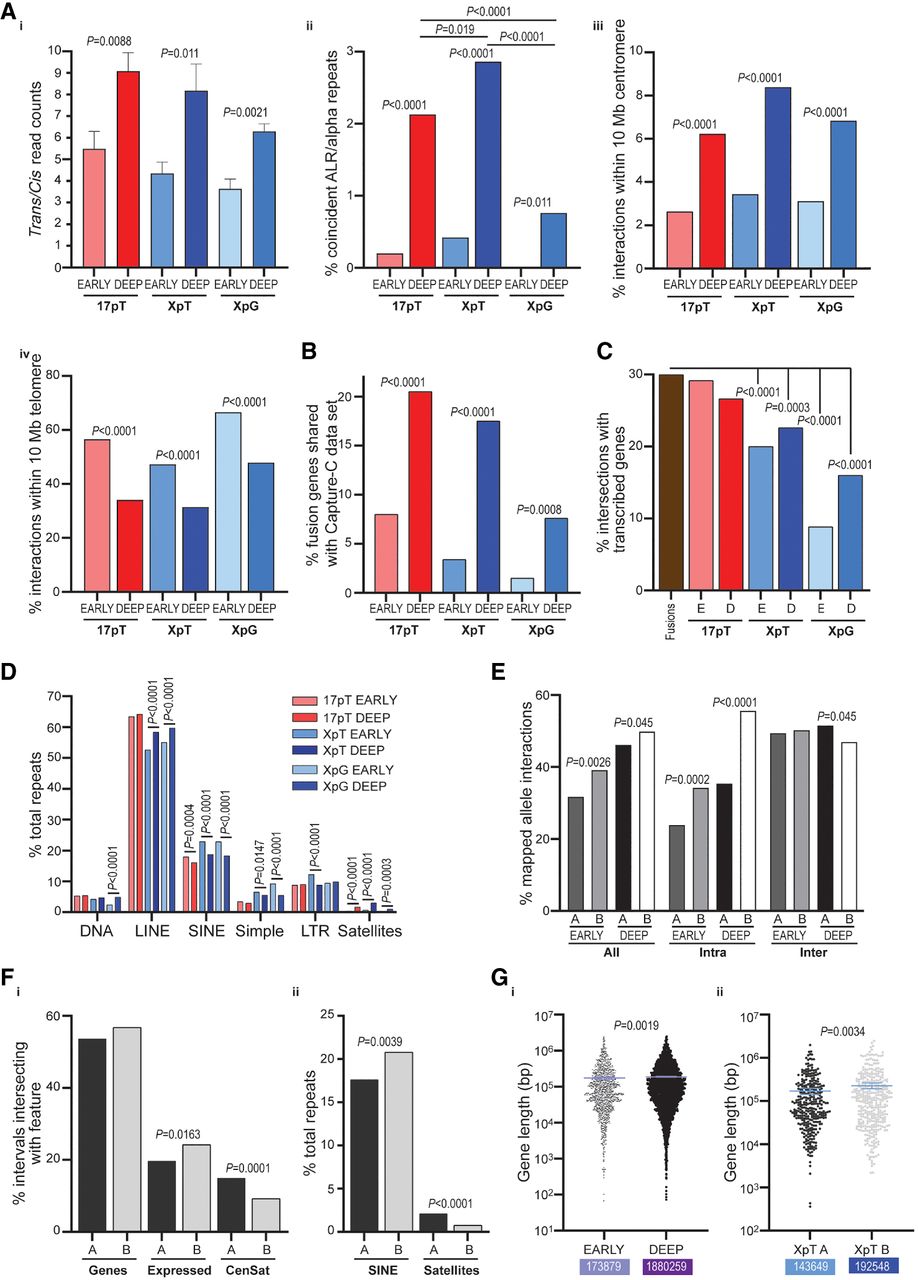
Crisis represents a transition in chromatin state and long-range chromosomal interactions. (A, i) Normalized read counts for all long-range trans compared with local cis chromatin Capture-C interactions determined by the Capcruncher pipeline. Triplicate samples of the Early- and Deep-crisis MRC5E6E7 sampling points using the Chr17p and ChrXp telomere-adjacent (17pT; XpT) and the ChrXp internal genomic (XpG) probes are displayed as means with 95% confidence intervals (CIs), analyzed using paired parametric t-tests. The mean sample percentages of interactions captured by the 17pT, XpT, and XpG probes in Early and Deep crisis that overlap with ALR/alpha satellite repeats (ii), are within 10 Mb of centromere (iii), or are within 10 Mb of telomere sequences (iv) are presented and compared using the N − 1 χ2 method. (B) The proportions of unique genes identified within crisis MRC5E6E7 telomere fusions sequenced in this and our former study (Liddiard et al. 2021) that overlap with genes captured by 17pT, XpT, or XpG probes in chromatin Capture-C experiments are shown and evaluated using the N − 1 χ2 method. (C) The proportions of genomic intervals associated with telomere fusion and chromatin Capture-C data sets that intersect with genes expressed in comparable crisis stage MRC5E6E7 samples (Liddiard et al. 2021) were computed using BEDTools intersect intervals (Quinlan and Hall 2010). Intersections with MRC5E6E7 telomere fusions were compared with intersections of each individual 17pT, XpT, or XpG probe Capture-C data set using the N − 1 χ2 method. (E) Early crisis, (D) Deep crisis. (D) The proportions of genomic intervals derived from chromatin Capture-C data sets (17pT, XpT, and XpG probes; Early- and Deep-crisis stages) that intersect with DNA repeats defined by RepeatMasker (x-axis) (Smit et al. 2013) are presented. The order of the data sets displayed corresponds to the adjacent key. (DNA) DNA repeat, (LINE) long interspersed repeat, (SINE) short interspersed repeat, and (LTR) long terminal repeat. Evaluation of differences employed the N − 1 χ2 method. (E) XpT chromatin Capture-C interactions were categorized according to the presence or absence of single-nucleotide variants (SNVs) characteristic of the long (A) or short (B) ChrXp telomere allele (Baird et al. 2003). The percentages of “all” and “intra”- or “inter”-chromosomal XpT interactions are compared for the Early- and Deep-crisis stages using the N − 1 χ2 method. (F) The proportions of genomic intervals associated with ChrXp A or B total allelic contacts that intersect with genes, expressed genes, and centromeric satellite (CenSat) repeats (i) or SINE and satellite DNA repeats (ii; delineated by RepeatMasker) (Smit et al. 2013) were analyzed using the same methodology. (G) The lengths of all genes (log10 scaling; means annotated within boxes below the x-axis) captured by the 17pT and XpT subtelomere probes at Early- and Deep-crisis stages (i) and the XpT A or B alleles at both crisis stages (ii). Means with 95% CI were compared using unpaired nonparametric Mann–Whitney U tests.