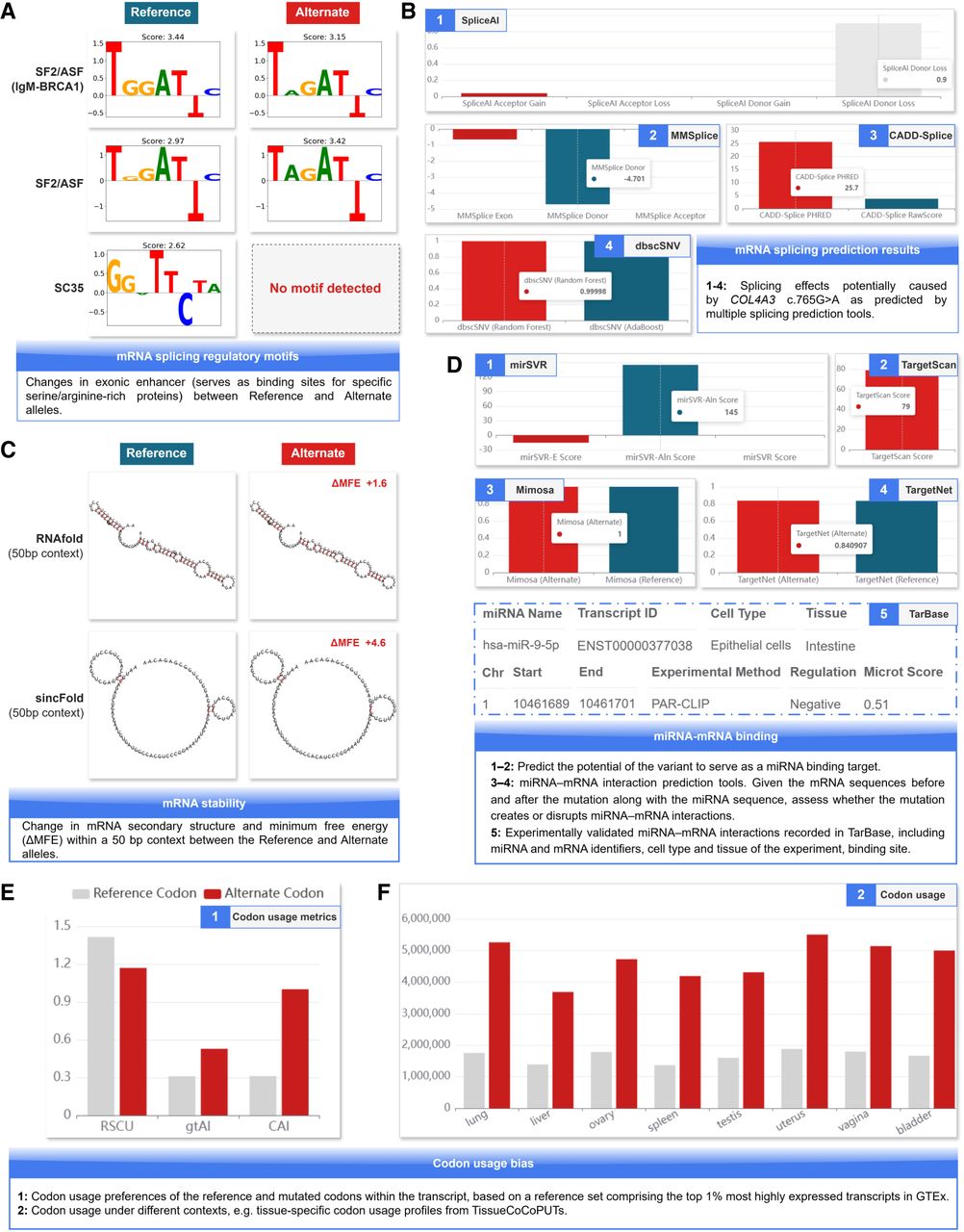
Case usages in the analysis module of SynMall. (A) SynMall uses ESEFinder 3.0 to compare the mRNA sequences before and after the COL4A3 c.765G > A mutation, assessing whether the variant alters serine/arginine-rich (SR) protein binding sites and may affect alternative splicing regulation. (B) SynMall provides splice prediction scores for COL4A3 c.765G > A: (1) SpliceAI predicts the gain or loss of donor/acceptor sites caused by the mutation; (2) MMSplice evaluates the likelihood of the site being a functional donor or acceptor; (3) CADD-Splice assesses the pathogenicity of splicing variant; and (4) dbscSNV uses the ensemble model to estimate the mutation's likelihood of altering splicing. (C) SynMall predicts the mRNA secondary structures of ACE c.2350G > A using RNAfold and sincFold and calculates changes in minimum free energy (MFE) to evaluate structural stability. (D) SynMall analyzes DFFA c.795G > A for miRNA–mRNA interaction changes: (1,2) mirSVR and TargetScan predict whether the variant is located in a potential miRNA binding site; (3,4) SynMall uses Mimosa and TargetNet to assess whether the mutation creates or disrupts interactions with specific miRNAs based on altered mRNA sequences; and (5) SynMall checks whether the variant overlaps experimentally validated miRNA–mRNA interaction sites, including binding positions, experimental context, and more. (E) SynMall presents codon-level metrics for USP28 c.1344T > G, including relative synonymous codon usage (RSCU), codon adaptation index (CAI), and gene-specific tRNA adaptation index (gtAI). (F) The codon usage count of GTT and GTG across various tissue types.