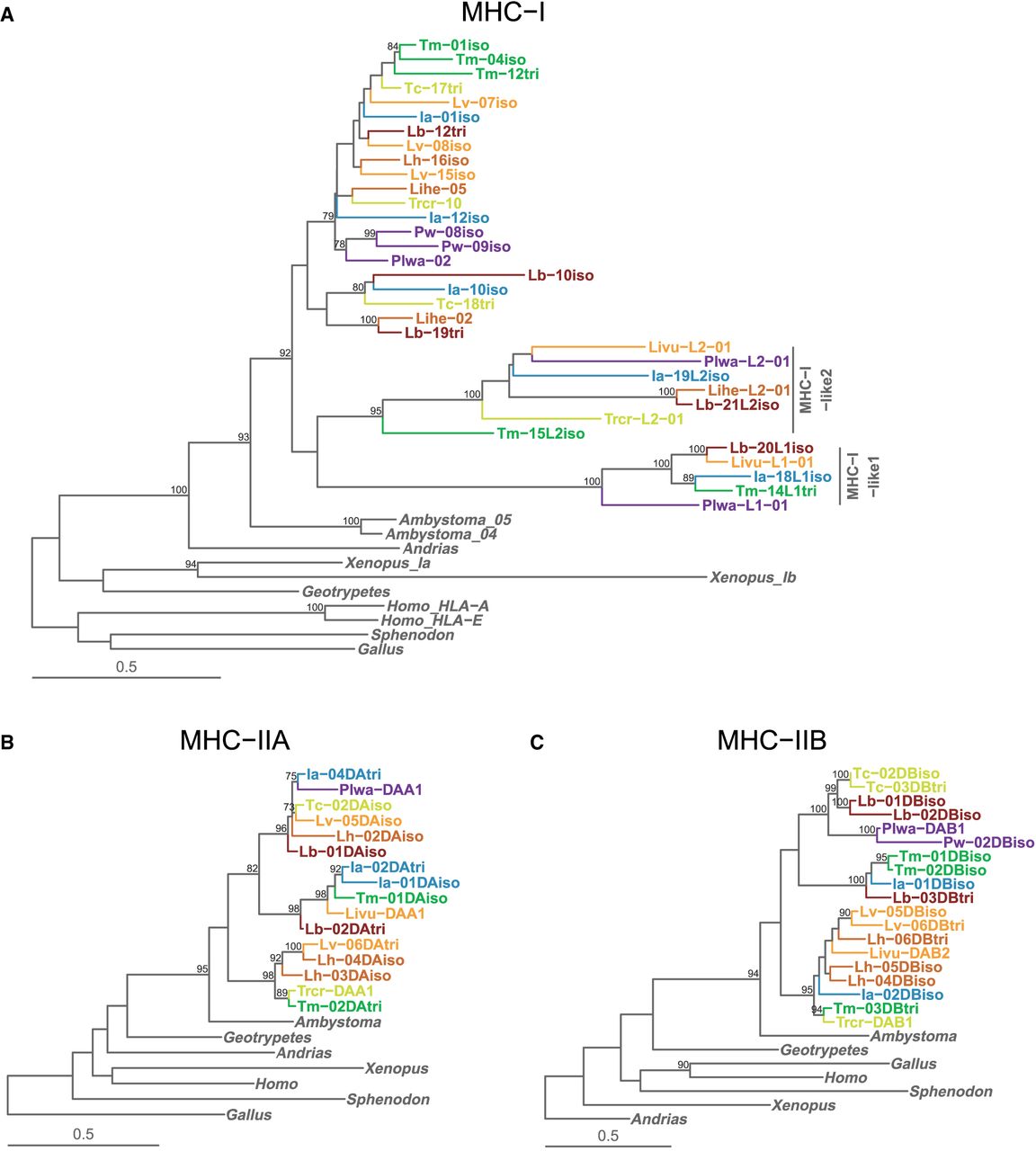
Phylogeny of newt MHC in the context of MHC sequences from other tetrapod taxa. The RAxML-NG maximum likelihood trees were constructed from protein sequences under the JTT+G4 amino-acid substitution model. The trees were rooted with zebrafish sequences (not shown). Support values for clades with the minimum bootstrap support of 70% (100 bootstrap replicates) are shown. The tree contains sequences from the G+T data set (as described in Methods) obtained from Pacific Biosciences (PacBio) Iso-Seq, de novo assembly of RNA-seq and protein sequences predicted for manually annotated MHC genes in genome assemblies of L. helveticus, L. vulgaris, P. waltl, and T. cristatus. Newt sequences are color-coded according to the species and species phylogeny is in Figure 1A. Additional salamanders included in the tree are the giant salamander (Andrias: GenBank AGY55962.1, AGY55988.1, AGY56015.1) and the axolotl (Ambystoma: sequences reported by Migalska et al. 2025). The trees include representatives of other major tetrapod groups, taken from GenBank or Ensembl (accessions starting with ENS): anurans (Xenopus: AAA16064.1, AAA16359.1, NP_001090513.1, BAA02842.1), birds (Gallus: ENSGALG00010003817, NP_001231990.1, ENSGALG00010003022), caecilians (Geotrypetes: XP_033779966.1, XP_033779817.1, XP_033779862.1), lepidosaurs (Sphenodon: ENSSPUG00000003482, ENSSPUG00000017679, ENSSPUG00000012680), and mammals (Homo: ENSG00000206503, ENSG00000204592, ENSG00000277263, ENSG00000196126). (A) MHC-I—a single (MHC-I-like1 and MHC-I-like2) or three (MHC-I) sequences randomly picked per newt species are included; for human and Xenopus, both MHC-Ia and MHC-Ib were included. (B) MHC-IIA, and (C) MHC-IIB—three sequences (if available) randomly picked per newt species were included.