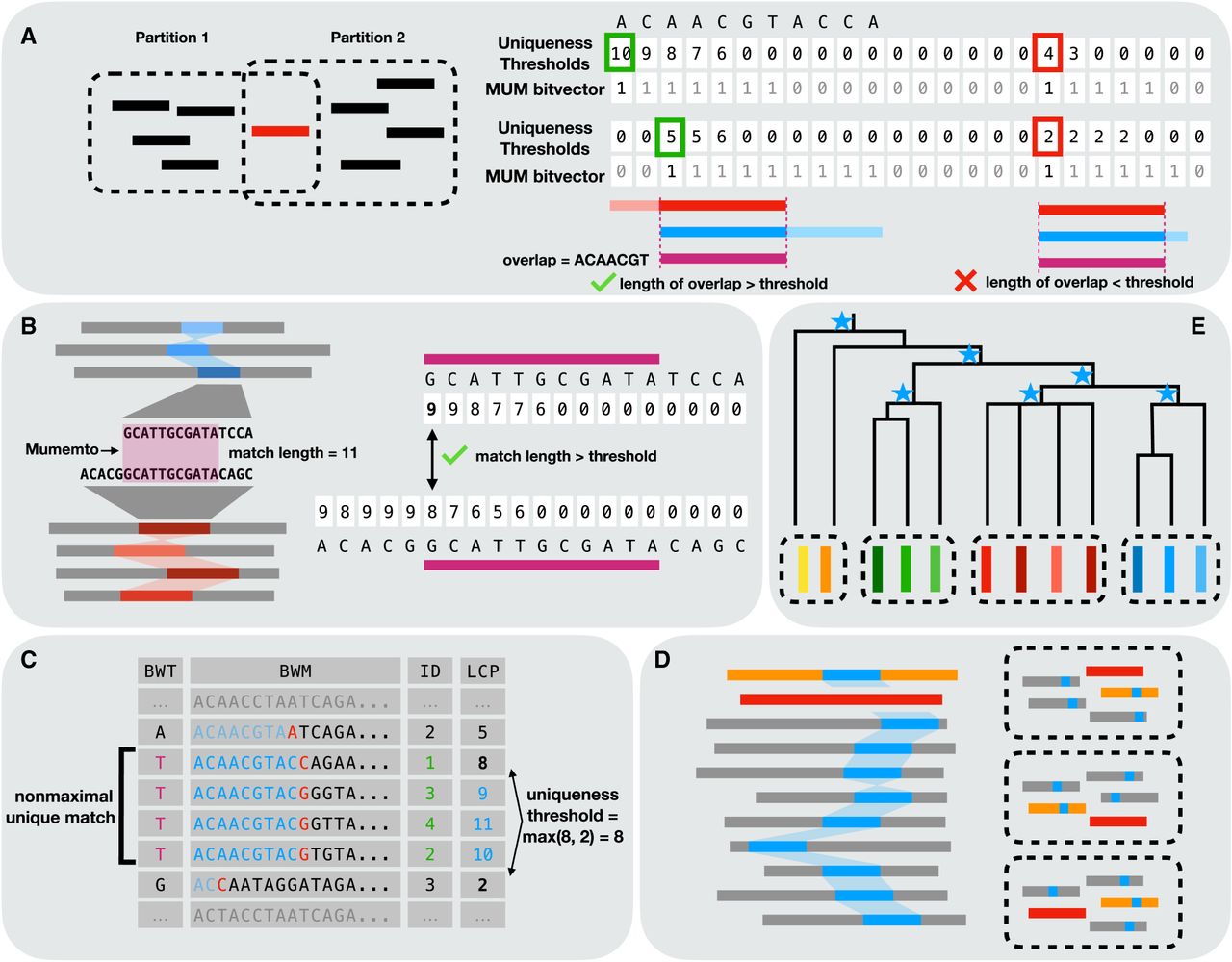
Overview of the MumemtoM algorithm. (A) Anchor-based merging requires a common sequence (red) present in each partition. Multi-MUMs are merged by identifying overlaps between partition-specific matches in the anchor coordinate space, and a uniqueness threshold determines if a MUM is still unique in each partition after truncation. (B) String-based merging enables computation of multi-MUMs between partitions without a common sequence. MUM overlaps are computed by running Mumemto on the MUM sequences, and the uniqueness threshold array ensures overlaps remain unique across the merged data set. (C) An example Burrows–Wheeler transform (BWT), matrix (BWM), and longest common prefix (LCP) array, with sequence IDs for each suffix shown (ID). A nonmaximal unique match (UM) is shown, and the uniqueness threshold for this match is found using the flanking LCP values. (D) A partial multi-MUM (in blue) is found in all-but-one sequence (excluded in red). Using two anchor sequences (red and orange), all-but-one partial MUMs can be computed using an augmented anchor-based merging method. (E) An example tree is shown, highlighting the string-based merging use case where partial multi-MUMs specific to internal nodes (starred) can be computed by merging subclade-based partitions up a tree.