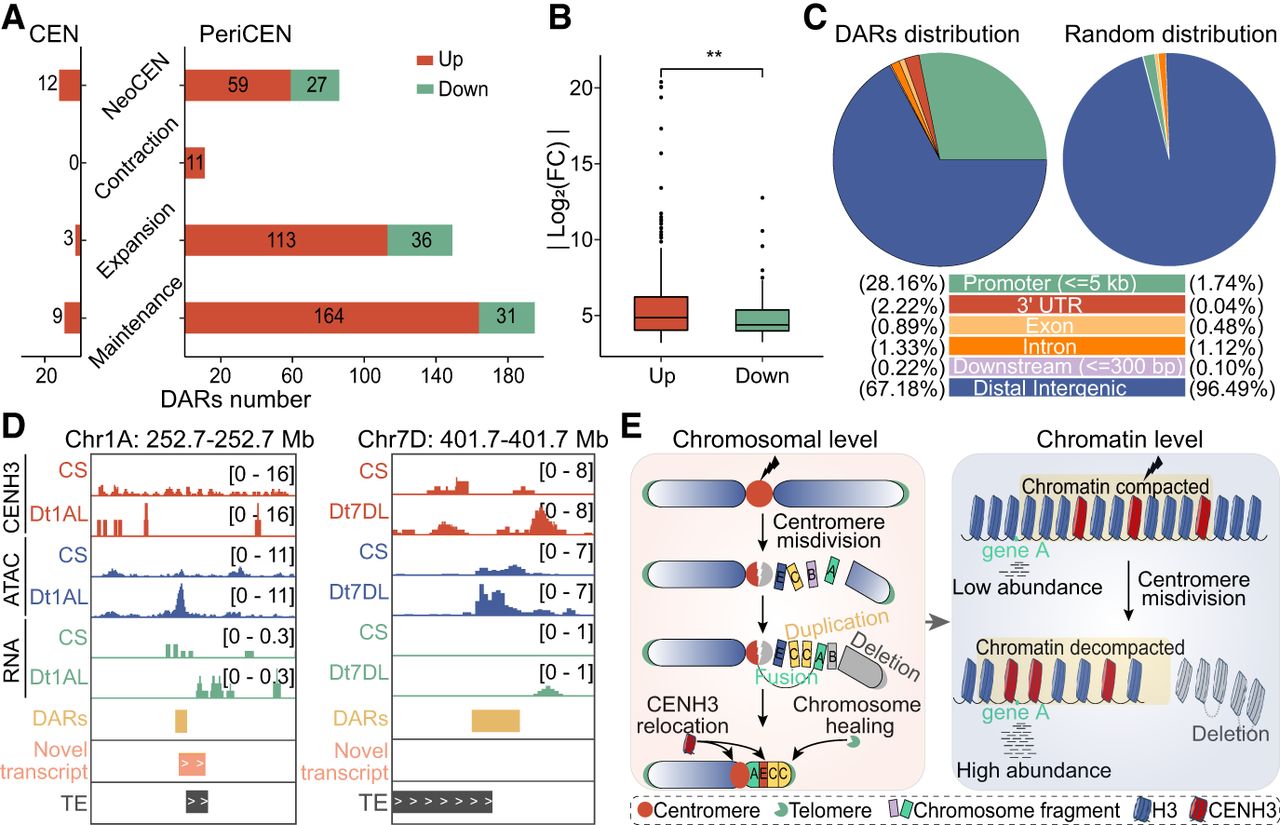
Enhanced chromatin accessibility facilitates transcriptional activation and promotes chromosome stability in damaged centromeres. (A) The number of differentially accessible chromatin regions (DARs) identified within (peri)centromeric regions of ditelosomic lines compared to CS wheat, stratified by centromere architecture types: neocentromere, contraction, expansion, and maintenance. Red and green bars represent upregulated (n = 371) and downregulated (n = 94) DARs, respectively. The number of DARs is highest in upregulated, reflecting increased chromatin remodeling. (B) Comparison of the absolute fold changes (|log2FC|) between upregulated (red) and downregulated (green) DARs. Upregulated DARs show significantly higher fold changes, indicating more pronounced chromatin opening. Statistical significance using Student's t-test: (**) P < 0.01. (C) Genomic distribution of DARs across functional regions within (peri)centromeric regions, including promoter (≤5 kb), 3′ untranslated regions (UTRs), exons, introns, downstream regions (≤300 bp), and distal intergenic regions. Observed distributions of DARs are compared with expected background frequencies of these various genomic regions, highlighting enrichment in promoter and intergenic areas. (D) Representative IGV snapshot of Dt1AL and Dt7DL lines compared to CS wheat, showing ATAC-seq (chromatin accessibility), RNA-seq (transcription activity), and CENH3 ChIP-seq signals within pericentromeric regions. DARs, novel transcripts, and TEs identified in ditelosomic lines are also indicated. The examples illustrate the emergence of open chromatin regions and transcriptional activation near restructured centromeres. (E) Schematic model illustrating how centromere damage initiates coordinated local changes in chromatin dynamics and transcriptional activation in wheat. Centromere breakage results in fragmental duplication, deletion, and, in some cases, a subset of these chromosomal fragmented pieces being randomly reassembled. This structural reorganization results in CENH3 nucleosome repositioning and neocentromere formations or altered centromere states. Concurrently, this process is coupled with localized, coordinated gene expression changes and open chromatin alterations that follow centromere misdivision, where enhanced chromatin openness promotes transcriptional activation and may contribute to chromosome stability in the absence of an intact canonical centromere.