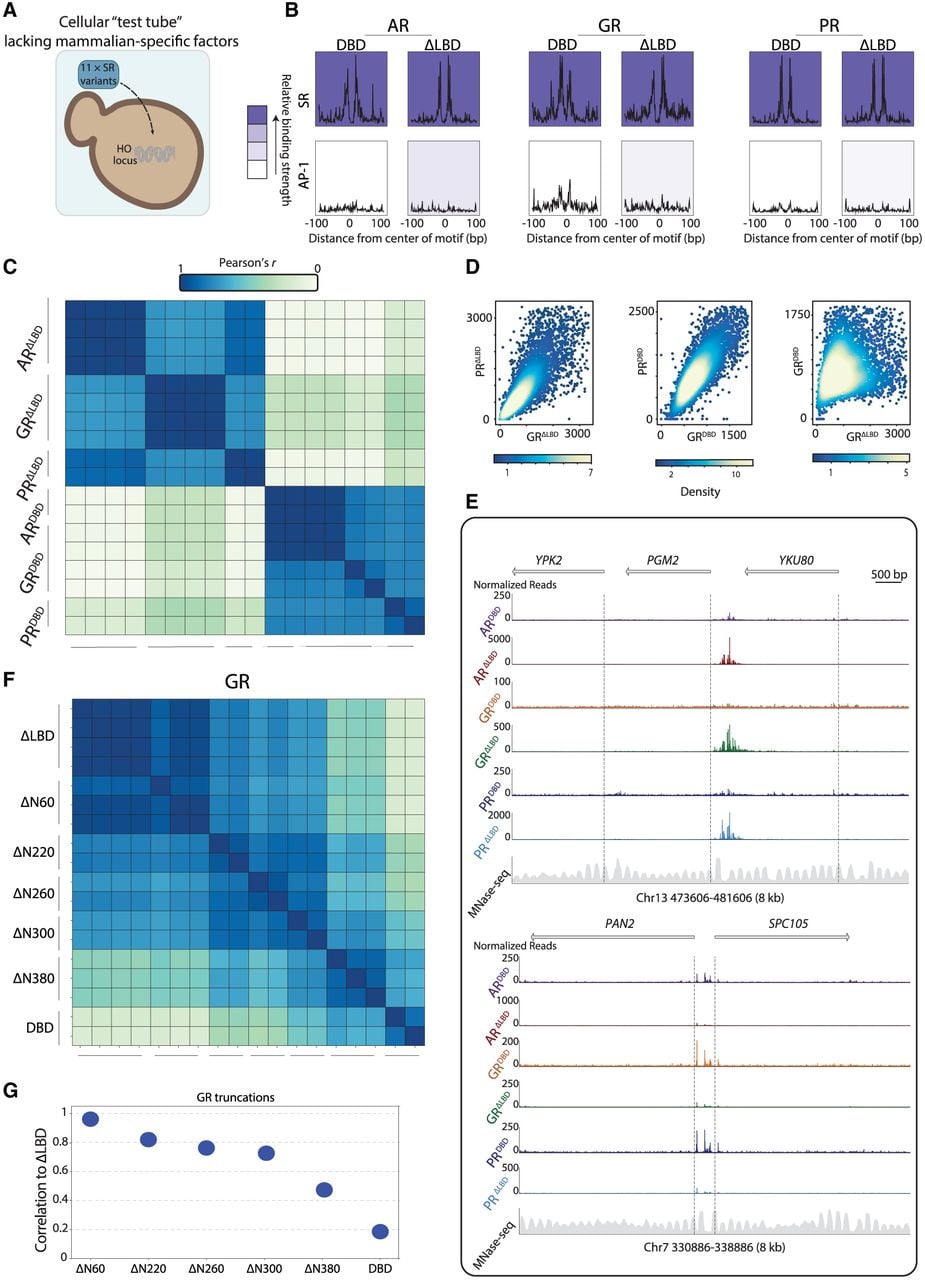
NTD directs SR binding across the budding yeast genome. (A) Using yeast as a “cellular test tube” to study NTD effects on the genome binding preferences of SRs. The three selected LBD-deleted SRs (ΔLBD) and the respective DBD-only mutants (DBD) were introduced into the yeast genome, and their binding profiles across the genome were measured using ChEC-seq. (B) Motif binding by LBD-deleted SRs and their DBD mutants. The average profiles of the indicated factors around mammalian-enriched motifs are shown at the indicated motifs; background color is as in Figure 5D. (C–E) The NTD directs SR binding preferences across the budding yeast genome. Shown are the correlations in promoter preferences of the indicated SR mutants (Methods), including multiple independent replicates (C), as well as respective scatter plots (showing here data in the Q1/Q3 ± 1.5 × IQR range), comparing promoter binding of the indicated strains in scatters (D) and representative binding tracks (E). (F,G) GR binding preferences shift gradually with increasing NTD truncation. The LBD-deleted GR truncation series was introduced into budding yeast, and their binding profiles were measured. The correlation matrix across all truncations (F) and the correlations of promoter preferences of the indicated truncations to the untruncated GR ΔLBD mutant (G) are shown.