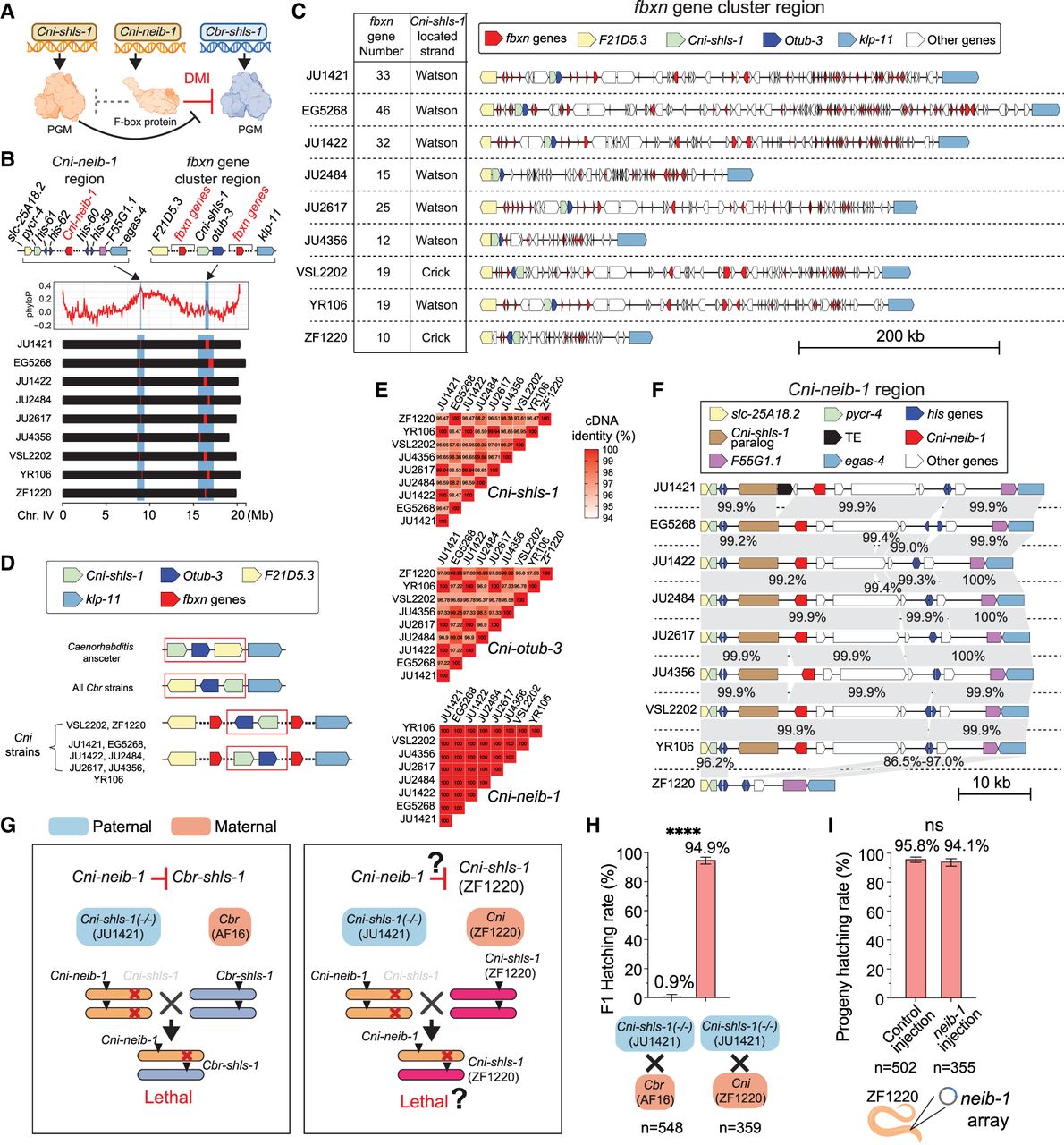
The fbxn gene family is highly polymorphic across C. nigoni populations. (A) Schematics illustrating the two-gene Dobzhansky–Muller incompatibility (DMI) between the F-box gene Cni-neib-1 and the phosphoglucomutase (PGM)-encoding gene Cbr-shls-1. The presence of Cni-shls-1 masks the DMI in F1 hybrids of the two species. (B) Chromosomal locations of Cni-neib-1 and all the other fbxn genes across C. nigoni strains. Gene models flanking Cni-neib-1 or the gene cluster containing other fbxn genes are shown on top. phyloP score distributions per 100 kb along Chr IV are also shown. C. elegans gene names except Cni-neib-1 and Cni-shls-1 are used for simplicity. (C) Gene models within the region containing the fbxn gene cluster in C. nigoni strains. The total number of fbxn genes and the strand (Watson or Crick) on which Cni-shls-1 is located are indicated. Genes are color-coded as follows: fbxn genes (red); conserved genes orthologous to those in other Caenorhabditis species including F21D5.3 (yellow), Cni-shls-1 (light green), otub-3 (dark blue), and klp-11 (light blue); and other remaining genes (white). All regions and gene models are shown to scale. (D) Schematic comparison of gene orders for the four orthologous genes (as shown in panel C) across Caenorhabditis ancestors, all C. briggsae strains, and all C. nigoni strains. Red boxes highlight differences in gene orders. Note that Cni-shls-1 and otub-3 are inverted only in C. nigoni wild isolate VSL2202 and ZF1220 compared with C. briggsae strains. (E) Heatmap showing cDNA sequence identity of Cni-shls-1 (top), Cni-otub-3 (middle), and Cni-neib-1 (bottom) across all C. nigoni strains. Note that Cni-neib-1 sequences are 100% identical across all strains. (F) Gene models flanking Cni-neib-1 in C. nigoni strains. Genes are color-coded as follows: Cni-neib-1 (red); conserved genes orthologous to those in other Caenorhabditis species including slc-25A18.2 (yellow) and pycr-4 (light green); histone genes (dark blue); a Cni-shls-1 paralog (brown); F55G1.1 (pink) and egas-4 (light blue); and other remaining genes (white). DNA sequence similarity among strains is also indicated. Note that only ZF1220 lacks the entire sequence containing Cni-neib-1 located between the histone genes. Sequence synteny (light gray) with similarity scores is also indicated. (G) Schematics showing the crossing strategy to evaluate potential negative interactions between Cni-neib-1 and Cni-shls-1 from ZF1220. (Left) F1 hybrids from the cross between Cni-shls-1−/− mutant (C. nigoni JU1421) and C. briggsae (AF16) are completely lethal owing to the incidental targeting of Cbr-shls-1 by Cni-neib-1. (Right) Intraspecific hybrid progeny from the cross between Cni-shls-1−/− mutant (JU1421) and ZF1220 are also expected to be lethal if Cni-neib-1 targets Cni-shls-1 from ZF1220. (H) Comparison of F1 hybrid hatching percentages between crosses of Cni-shls-1−/− fathers with C. briggsae mothers or C. nigoni (ZF1220) mothers. (****) P < 0.0001, Fisher's exact test. Error bars, 95% CI. (I) Comparison of progeny hatching rates of C. nigoni (ZF1220) injected with control buffer versus amplified Cni-neib-1 sequences. P = 0.2636, Fisher's exact test. Error bars, 95% CI.