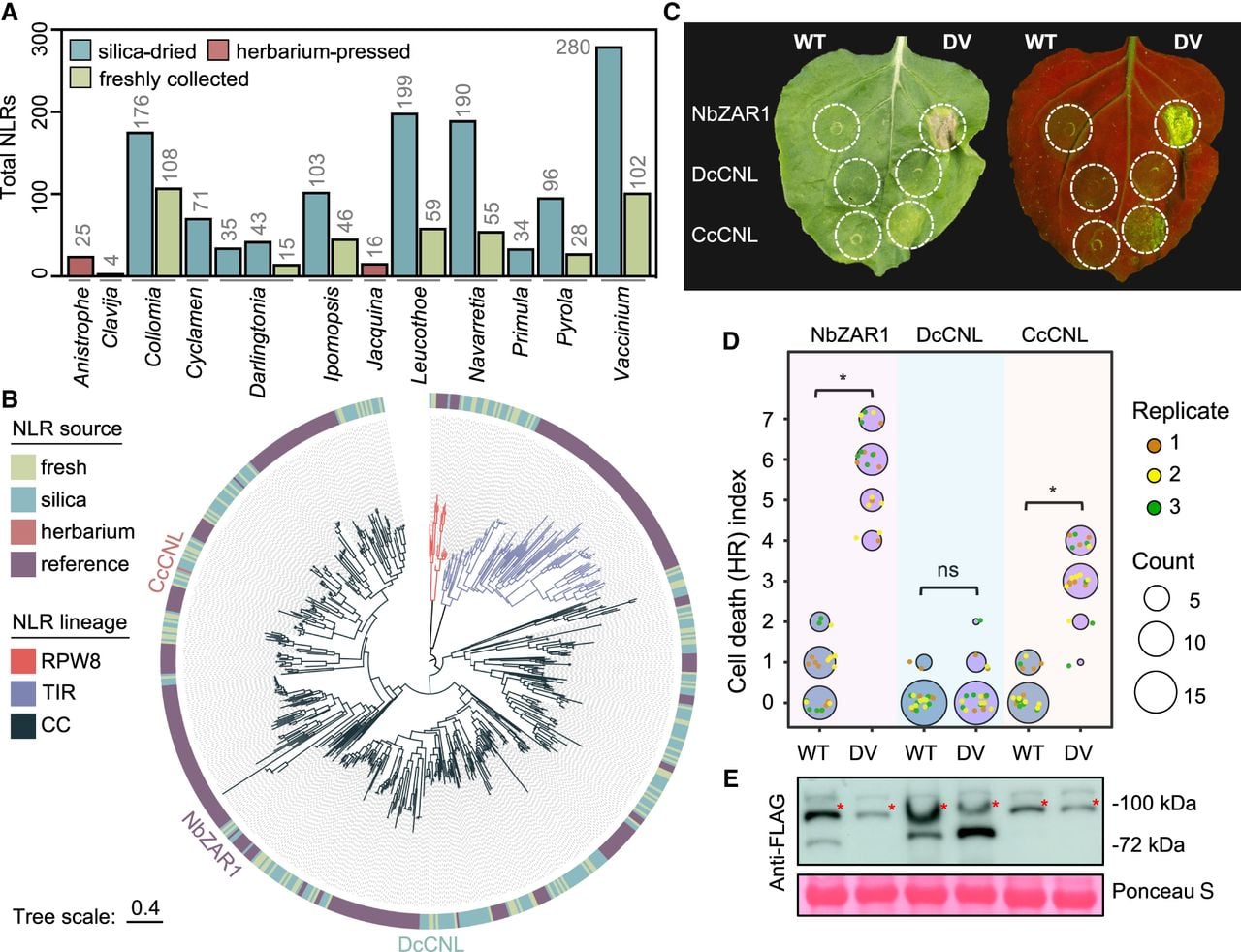
An NLR immune receptor sourced from a 68-year-old herbarium specimen of Clavija costaricana is functionally transferable to Nicotiana benthamiana. (A) Total number of NLRs identified in each transcriptome sample. (B) Maximum likelihood phylogeny of NLR immune receptors based on the central NB-ARC regulatory domain. The outer ring indicates whether each NLR was sourced from herbaria samples, silica samples, or fresh samples or belongs to a reference set of functional NLRs from flowering plants. Branch color represents NLR lineage: RPW8-NLRs (RPW8), TIR-NLRs (TIR), or CC-NLRs (CC). The three tested CC-NLRs (CNLs) are labeled on the tree. Tree scale = substitutions/site. (C) HR cell death phenotypes induced by wild-type (WT) or autoactive (DV) variants of DcCNL-3xFLAG (derived from silica-dried Darlingtonia), CcCNL-3xFLAG (derived from herbarium-pressed Clavija), or the NbZAR1-3xFLAG control in N. benthamiana. Leaves were imaged 7 days post agroinfiltration under bright light as well as UV light, in which cell death responses appear as green fluorescence. (D) Quantification of HR cell death performed 7 d post agroinfiltration. Data from three independent experimental replicates are shown (n ≥ 5 infiltrations per replicate). Statistically significant differences between the means of WT and DV treatments are indicated with an asterisk (Kruskal–Wallis test, P < 0.01; ns = not significant). (E) Immunoblots of all tested NLRs 2 d post agroinfiltration. Total protein levels were visualized with Ponceau S staining. Immunoblotting was repeated twice with similar results. Red asterisks indicate proteins of interest.