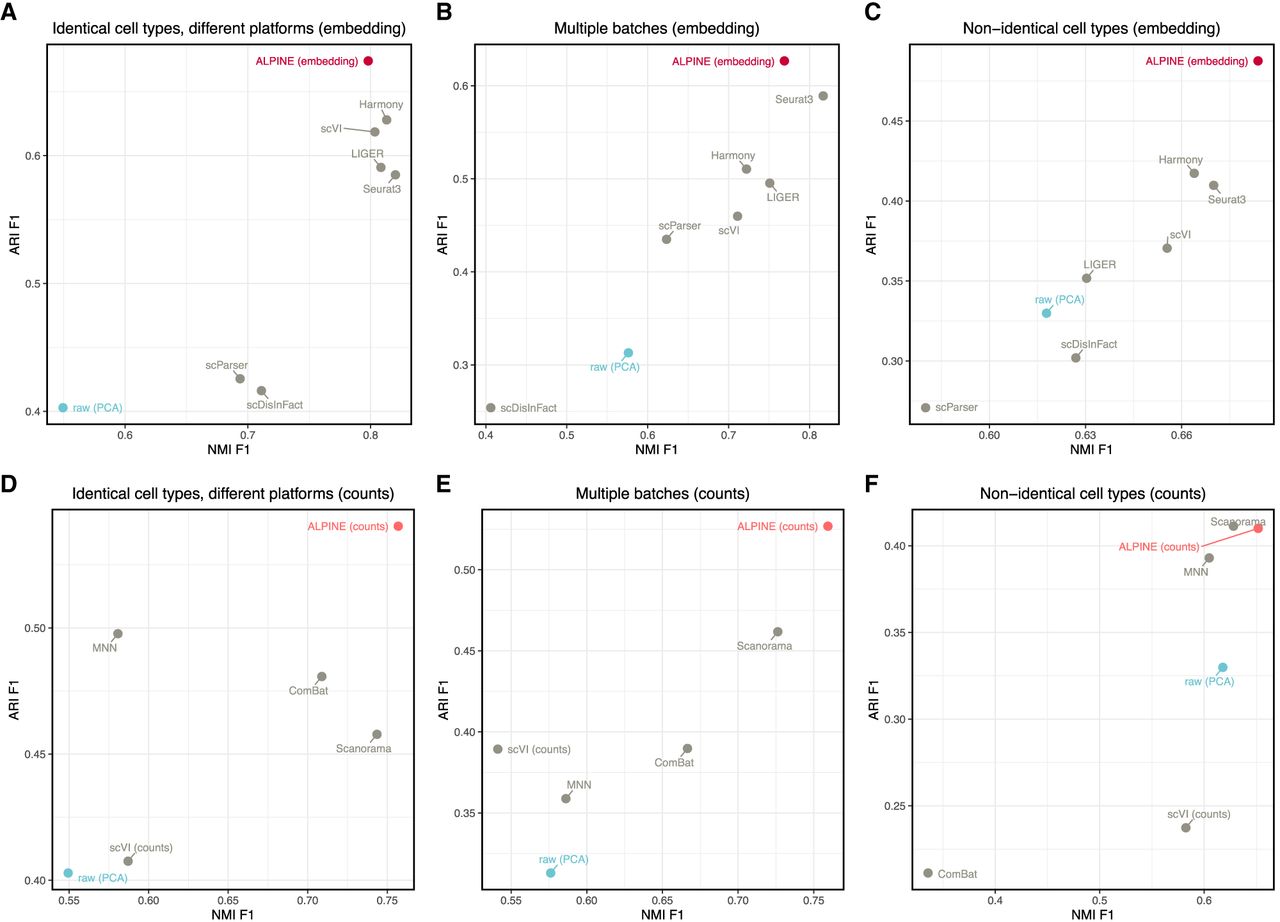
Comparative study of ALPINE against other methods for batch effect removal and cell-type clustering. Adjusted rand index (ARI) and normalized mutual information (NMI) of ALPINE versus scDisInFact (Zhang et al. 2024), scParser (Zhao et al. 2024), Seurat3 (Stuart et al. 2019), Harmony (Korsunsky et al. 2019), LIGER (Liu et al. 2020), scVI (Lopez et al. 2018), Scanorama (Hie et al. 2019), MNN (Haghverdi et al. 2018), and ComBat (Johnson et al. 2007), in batch effect removal using three real data sets based on cell-type clustering with Leiden (using default resolution = 1). Methods producing low-dimensional embeddings (scDisInFact, scParser, Seurat3, Harmony, LIGER, scVI) are compared with ALPINE embeddings in A–C, whereas methods reconstructing counts (Scanorama, MNN, ComBat, and scVI [counts]) are compared with ALPINE-reconstructed counts in D–F. (A,D) Human peripheral blood monouclear cell data sets with two batches and matched cell types. (B,E) Pancreatic cells data set with five batches and matched cell types. (C,F) Mouse retina data with two batches and nonidentical cell types.