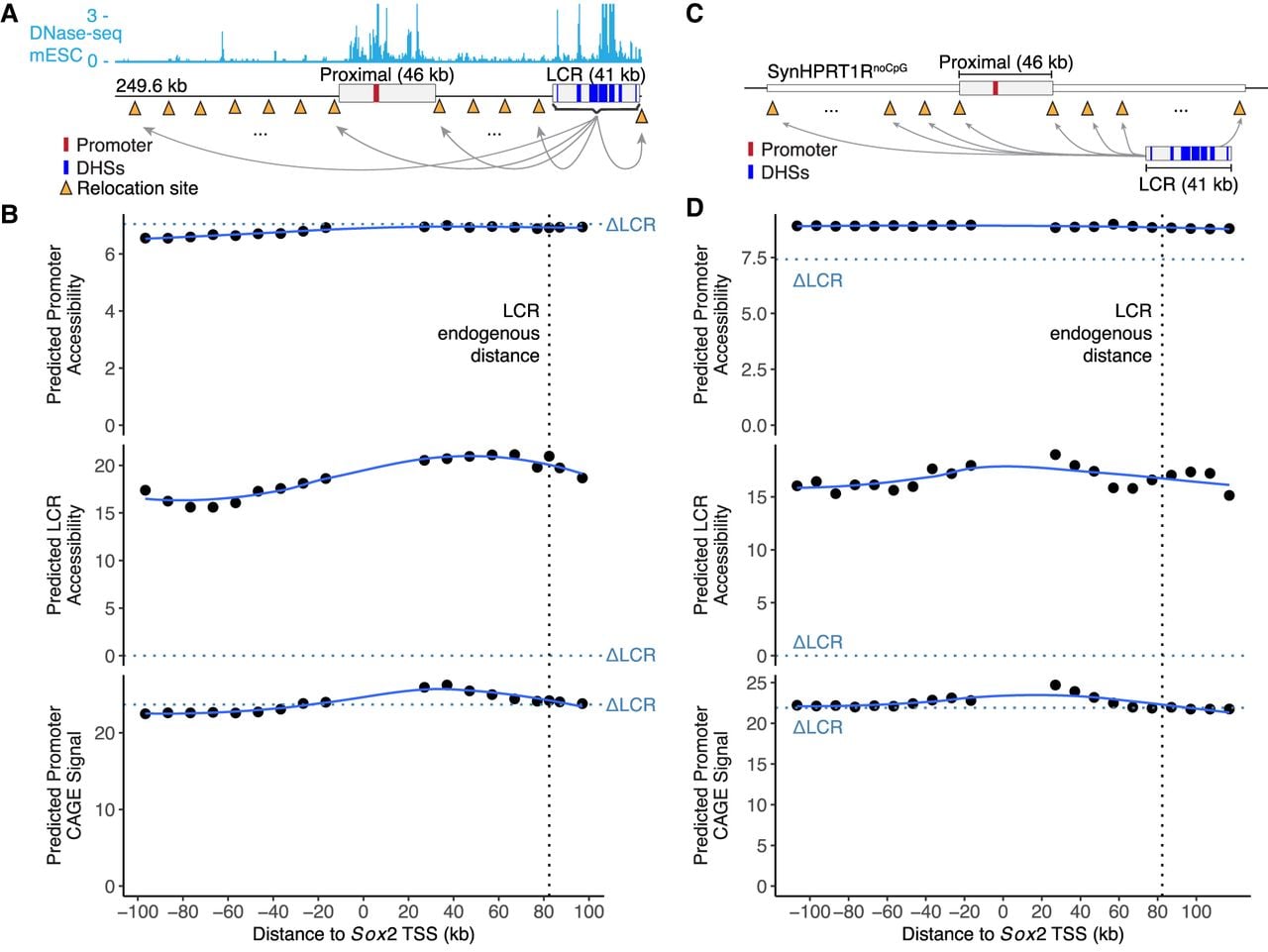
Enformer does not predict effect of LCR relocation on Sox2 accessibility or expression. (A,C) Schematics of relocation simulation of the Sox2 LCR in 10 kb intervals surrounding the promoter in its endogenous locus (A) or neutral synthetic sequence (SynHPRT1RnoCpG; C). Red rectangles indicate Sox2 promoter; blue rectangles, LCR DHSs 19–28. (B,D) Enformer predictions for a 249.6 kb window encompassing the whole virtual locus, and any remaining space was filled with N's. Each point represents predicted accessibility of Sox2 promoter (top) or LCR (middle) or promoter CAGE signal (bottom) for a given distance between Sox2 TSS and LCR. Promoter CAGE signal and accessibility were measured as the site maximum predicted signal; LCR accessibility, as the sum of DHSs 19–28 maximum predicted signal. The vertical black dotted line indicates the endogenous LCR distance to TSS. Horizontal dotted blue lines indicate prediction when LCR was replaced by a SynHPRT1RnoCpG fragment of the same size. Solid blue lines show LOESS fits.