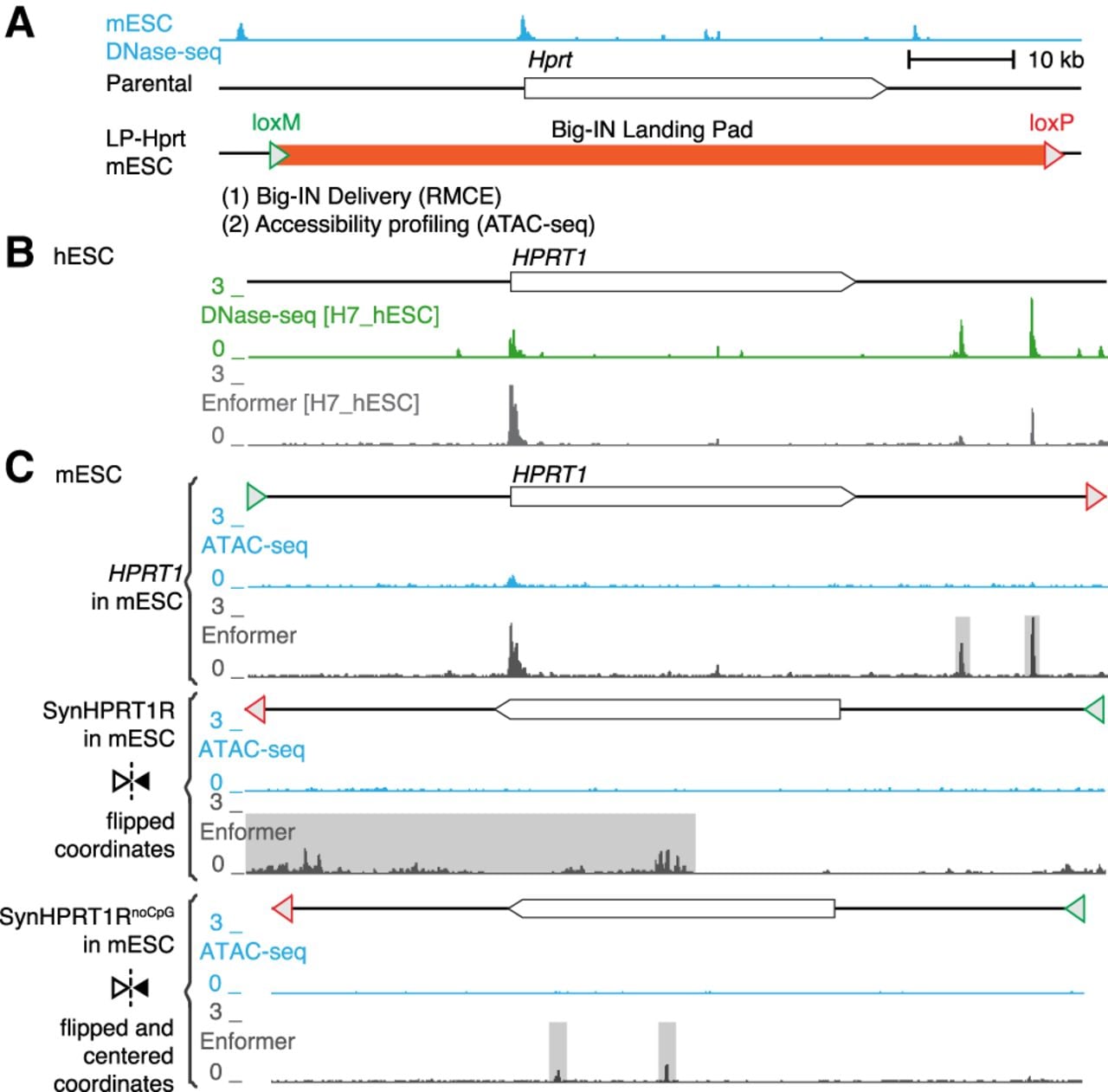
Limited predictive performance on novel synthetic sequences. (A) Schematic of mouse Hprt1 locus and synthetic payload profiling strategy (Camellato et al. 2024). mESC DNase-seq is shown at top. mESCs were engineered to replace their Hprt1 locus with Big-IN LP, which was used to deliver three synthetic payloads: human HPRT1 locus, SynHPRT1R (reversed but not complemented human HPRT1 locus), and SynHPRT1RnoCpG (SynHPRT1R with all CpG removed) payloads. Engineered cells were characterized by ATAC-seq. (B) Schematic of human HPRT1 locus. Shown is DNase-seq of human H7_hESC and corresponding Enformer prediction. (C) ATAC-seq and Enformer accessibility predictions for engineered mESCs. Shown synthetic payloads (HPRT1, SynHPRT1R, and SynHPRT1RnoCpG) profiled and predicted accessibility. Schematics of each synthetic payload are shown above the accessibility tracks. Reversed payloads (SynHPRT1R and SynHPRT1RnoCpG) are flipped horizontally, and SynHPRT1RnoCpG was centered to match HPRT1 coordinates. Enformer false-positive predictions are highlighted in gray.