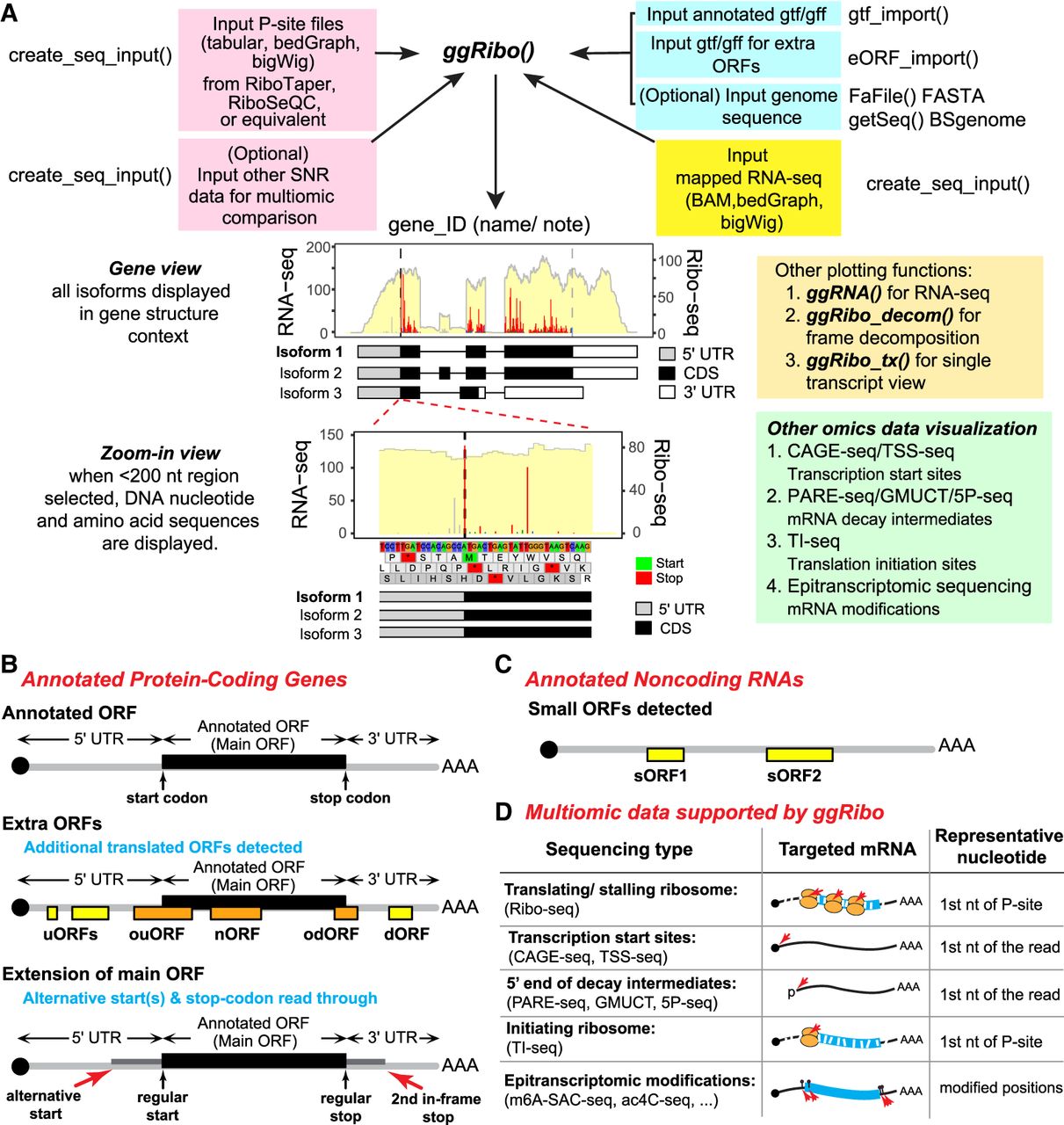
Overview of ggRibo and the ORF/data types supported. (A) Input/output and the functions of ggRibo. ggRibo requires Ribo-seq P-site information, genome annotation for annotated ORFs and (optional) extra ORFs, and mapped RNA-seq file(s). Other omics data presented with single-nucleotide resolution (SNR) can be input and visualized in parallel or independently. To visualize DNA and/or amino acid sequences, users can optionally provide the corresponding genome sequence file. Output plots can be in various scales, such as gene view or zoomed-in view. (B,C) ORF types can be visualized by ggRibo. Annotated genes are typically grouped into either coding (B) or noncoding (C), and ggRibo can plot ORFs in both gene types. For annotated protein-coding genes, typically only one ORF (main ORF) is annotated, whereas for annotated noncoding RNA genes, no ORF is annotated by default. By providing GTF/GFF files that include extra ORFs, users can visualize any ORF beyond those already annotated. “Extra ORFs” may be translated using a frame different from the main ORF and/or separate from the main ORF, including upstream ORFs (uORFs) within the 5′ UTR and downstream ORFs (dORFs) within the 3′ UTR. Some of the uORFs and dORFs may partially overlap with the main ORF (ouORFs and odORFs). Some overlapping ORFs may be nested within the main ORF (nORF). In contrast, “extension of main ORFs” uses the same reading frame as the main ORF and extends from 5′ or 3′. The fExtend and tExtend parameters allow extending the main ORF frames into the 5′ UTR and 3′ UTR, respectively. This enables investigating translation from alternative AUG or non-AUG start codons in the 5′ UTR or stop-codon readthrough events in the 3′ UTR. For annotated noncoding RNAs, some small ORFs (sORFs) may be translated. (D) Example omics data types with SNR that can be plotted by ggRibo.