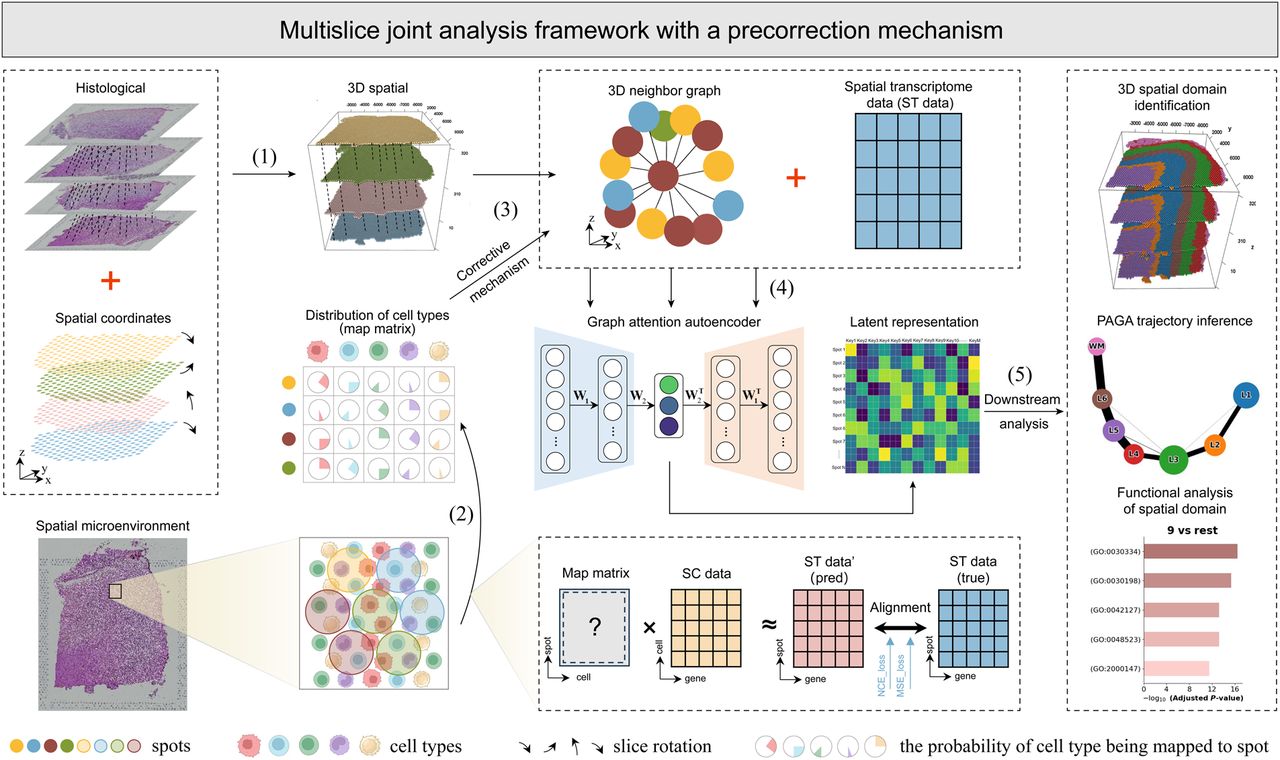
Overview of STMSC. (1) Slice alignment: uses iterative closest point (ICP) (Arun et al. 1987) to align multiple slices, establishing the three-dimensional (3D) positions of spots and constructing a global 3D structure. (2) Microenvironmental deconstruction: trains a cell-to-spot mapping matrix M using spatial transcriptomic (ST) gene expression data (Xst) and single-cell data (Xsc) via a spatially informed contrastive learning model. In this model, the similarity of positive pairs (i.e., spatially adjacent spots) is maximized, whereas the similarity of negative pairs (i.e., spatially nonadjacent spots) is minimized. (3) Construction and correction of 3D neighborhood graph. (4) Joint modeling: STMSC jointly models multiple slices and employs a graph attention mechanism-based autoencoder to learn latent spot representations with 3D spatial information. (5) Downstream analysis: The learned latent representations serve as inputs for downstream analysis, including 3D spatial domain identification and spatial trajectory inference.